
UCCCC Release and Custody Paths
Union City Community Corrections Center is a state facility operated by the Oklahoma Department of Corrections. Its residents are in ODOC custody. Work release, community placement, a reentry class, or an approved trip outside the secure site does not by itself end the sentence. That is the first distinction to make when someone appears to be “out” of UCCCC.
A later status event may be parole, full discharge, movement to another ODOC location, a detainer transfer, or release to ICE. Parole means the person serves the remaining term in the community under supervision. Discharge ends the ODOC term. A detainer is a request or basis for another authority to take custody. These outcomes should not be grouped under one generic release label.
| Status | What it means |
|---|---|
| Community correction or work release | Authorized community activity while ODOC custody continues. |
| Parole | Community supervision for the remaining term. |
| Discharge | The ODOC term has ended. |
| Detainer or ICE transfer | Another authority may take custody. |
| Facility transfer | ODOC custody continues at another location. |
Check UCCCC Release Records
Open the ODOC Offender Lookup, accept its disclaimer, and search by ODOC number when possible. A full-name search is the fallback. Compare the photo and other identifiers, then read the status or location together with the sentence panel. A community location may mean supervision or community custody, not final discharge. The abbreviated public result is a locator, not a complete sentence audit.
- Search the exact ODOC number or full legal name.
- Verify identifiers before opening a same-name record.
- Read location, custody status, and sentence entries together.
- If parole appears relevant, match the DOC number in PPB dockets or results.
- Request the Certificate of Release or status-change notice for the exact disposition.
ODOC cautions that public information can be abbreviated. Its FAQ also treats a projected release date as tentative and limits access to some date information. Do not turn a projected date into proof that someone left UCCCC. For a broader comparison of county, state, and federal paths, use the Canadian County released-inmate lookup.
UCCCC Discharge Record Documents
ODOC’s Section 06 forms identify two records that are more exact than a broad online status: the Certificate of Release, DOC 060211N, and Notice of Inmate Status Change, DOC 060211O. The underlying sentence-administration policy uses categories that include discharge, parole, rebill, death, new sentence or probation, new detainer, and release to ICE. Asking for the precise category avoids the ambiguity of “released.”
Contact ODOC Offender Records and Registries when a durable UCCCC release record is needed. Closed Records uses 405-425-2691. The general email is osor@doc.ok.gov, while discharge-only requests use osordischarges@doc.ok.gov. Include the name and DOC number. Ask for the final custody or supervision status, date, and type instead of a custom explanation.
The official ODOC release and status-change forms index shows the named records.
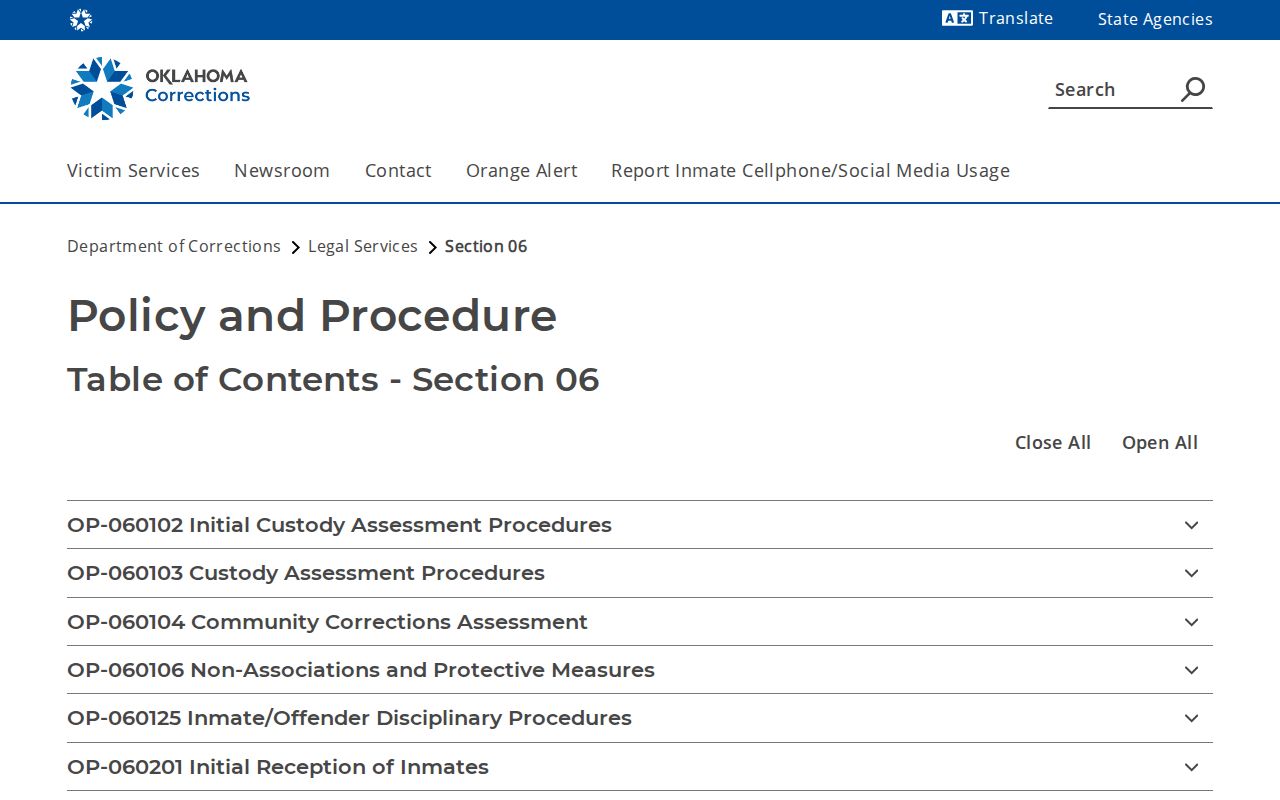
Those forms provide the strongest route for separating UCCCC parole, discharge, and transfer when the public locator is not specific enough.
UCCCC Records and Contact
The facility can answer current operational questions, while ODOC’s records office owns the formal state custody record. The researched fact sheet supplies the facility address, phone, security level, programs, and capacity. It does not turn facility staff into a public release-date calculator. An individual’s projected date can change, and some date details may be confidential.
Union City Community Corrections Center700 N. Highway 81
Union City, OK 73090
Phone: 405-483-5900
Use the facility number to confirm the right contact for an authorized current matter. Use Offender Records and Registries for a release certificate, discharge confirmation, or formal status document. If parole was part of the path, the Oklahoma Pardon and Parole Board record shows the decision stage, while ODOC confirms the resulting custody or supervision status.
The ODOC legal-services page identifies the offender-records route.
The state records channel, rather than CCSO Records, is the right source for a UCCCC discharge document.
UCCCC Release Setting
ODOC’s August 2025 fact sheet states that UCCCC has capacity for 228 people. It describes a community-corrections and work-release setting with reentry and transitional programming. These programs prepare people for later community life, but program participation does not equal completed custody.
The sheriff’s 72-hour release page does not cover UCCCC merely because both facilities sit in Canadian County. That county feed documents departures from the Canadian County Jail. UCCCC belongs to a statewide sentence-administration system. A separate county booking might create a CCSO record, but the UCCCC episode remains an ODOC matter.
Note: A work-release participant can be outside the building and still remain under ODOC control.
UCCCC Detainers and ICE Releases
A UCCCC status change can include a new detainer or release to ICE. In either case, departure from ODOC does not by itself prove return to the community. Request the status-change record, identify the receiving authority, and then consult that authority’s tool. ICE’s locator has scope and timing limits, so a no-match should not override an ODOC document showing the handoff.
Canadian County also has a CCSO 287(g) memorandum. That county-jail arrangement does not make UCCCC a sheriff facility and should not be used as proof of the state center’s role. The relevant UCCCC evidence is ODOC’s own record category. This custodian-first rule keeps two different government systems from being merged merely because they operate nearby.
If the record says parole rather than ICE transfer, check the Pardon and Parole Board action for the decision history and ODOC for the live supervision status. A favorable board action is not the release certificate.
UCCCC Release History and Identity
The UCCCC building has a distinctive history. The official fact sheet says it was built in 1999 as an Avalon high-security juvenile facility, became UCCCC in 2005, and was purchased by ODOC in 2006. Its former purpose does not make the current center a juvenile facility. Today’s UCCCC records are adult ODOC records and must be searched through the state corrections route.
This history also shows why names and custodians matter more than a building alone. The same site can serve a different agency and population over time. A current release claim should rest on the present operator, the person’s DOC number, and the current record, not on an old description of the property.
For a released-first reading, compare three sources when the facts justify it: the judgment and sentence for the legal term, a current ODOC or PPB projected date for the forecast, and the Certificate of Release or status-change notice for what actually happened. Each document answers a different question.
UCCCC Offender Search Fields
An ODOC result commonly includes the person’s name, DOC number, photograph or identifiers, physical descriptors, status or location, and offense and sentence entries. No one field should control the conclusion. A UCCCC location supports current placement at that facility when the result is current. A community or supervision label can show a later stage while the state still exercises authority. A closed or discharge-related status is stronger evidence of completion, but the named release document remains the best way to establish the exact change.
The public lookup warns that it is abbreviated and not an exact account of the offense, sentence details, or time to be served. That warning matters with work release because physical movement can look like release to someone who sees only one moment. Match the DOC number, inspect the full status, and avoid using a county case alone as proof of the ODOC outcome.
| ODOC field | How to use it |
|---|---|
| DOC number | Match the person across ODOC and PPB records. |
| Status or location | Distinguish prison, UCCCC, community supervision, and closed status. |
| Sentence panel | Provides abbreviated offense and term context. |
| Photo or identifiers | Helps prevent a same-name mismatch. |
If PPB was involved, its Board Action may also show the county, case number, sentence term, parole-eligibility date, projected release date, and exact action. Eligibility and a favorable action are decision stages. Confirm the later ODOC status before stating that the person left UCCCC.
UCCCC Projected Release Limits
ODOC’s projected release date is a forecast, not a scheduled gate event. Earned-credit levels, misconduct, achievement credits, amended judgments, new cases, detainers, and parole action can change the calculation. ODOC also says release-date information may be confidential without a legitimate need. A public result should never be forced into a date it does not show.
For someone at UCCCC, community placement adds another reason to avoid shorthand. The person may have moved from a more secure institution while the same state sentence continues. Compare the controlling judgment, any PPB projected date or action, and the later release certificate. That sequence separates a sentence term, a forecast, and an actual state status event.