
Canadian County Jail Release Paths
Canadian County Jail, also called the Canadian County Detention Center, holds both people awaiting court action and people serving sentences. Leaving the building does not describe one single legal outcome. The Canadian County Sheriff’s Office release feed may report a bail bond, cash bond, own-recognizance release, entered plea, dropped hold, or transfer to another agency. Bond and own recognizance can return a person to the community while the case continues. An entered plea needs the court docket for the full sentence and disposition.
The most important label is TOT OTHER AGENCY. It records a handoff, not freedom in the community. The receiving custodian may be the Oklahoma Department of Corrections, another county, a federal authority, or immigration authorities, depending on the actual record. The sheriff’s Civil Division also reports responsibility for ODOC, warrant, court-order, extradition, and juvenile transports. That makes cross-system movement a normal part of local operations. Always identify the next custodian before describing where a person went.
Confirm Canadian County Jail Releases
The official CCSO released-inmates page is the first source for a recent county-jail event. It covers a rolling 72-hour window and sorts entries by release date. Match the full name, booking number, booked time, arresting agency, and released time. Then read the exact reason. Do not rely on the first similar name, and do not translate an agency term into a broader claim than it supports.
- Open the sheriff’s released list and note when it was checked.
- Match the person by name and booking number when available.
- Record both booking and release timestamps, not just the calendar dates.
- Read the stated reason and trace any transfer to its receiving system.
- Use OSCN for the court event or request the booking and release sheet for an older entry.
The release page does not show charges, a photograph, or a linked booking profile. Its update interval is not published. If a name is missing, the event may be older than the displayed window, still updating, spelled differently, sealed, or under another custodian. The broader Canadian County released-inmate search and record path explains how the court, VINE, ODOC, BOP, and ICE sources fit together.
The official release feed shows the layout and release fields captured below.
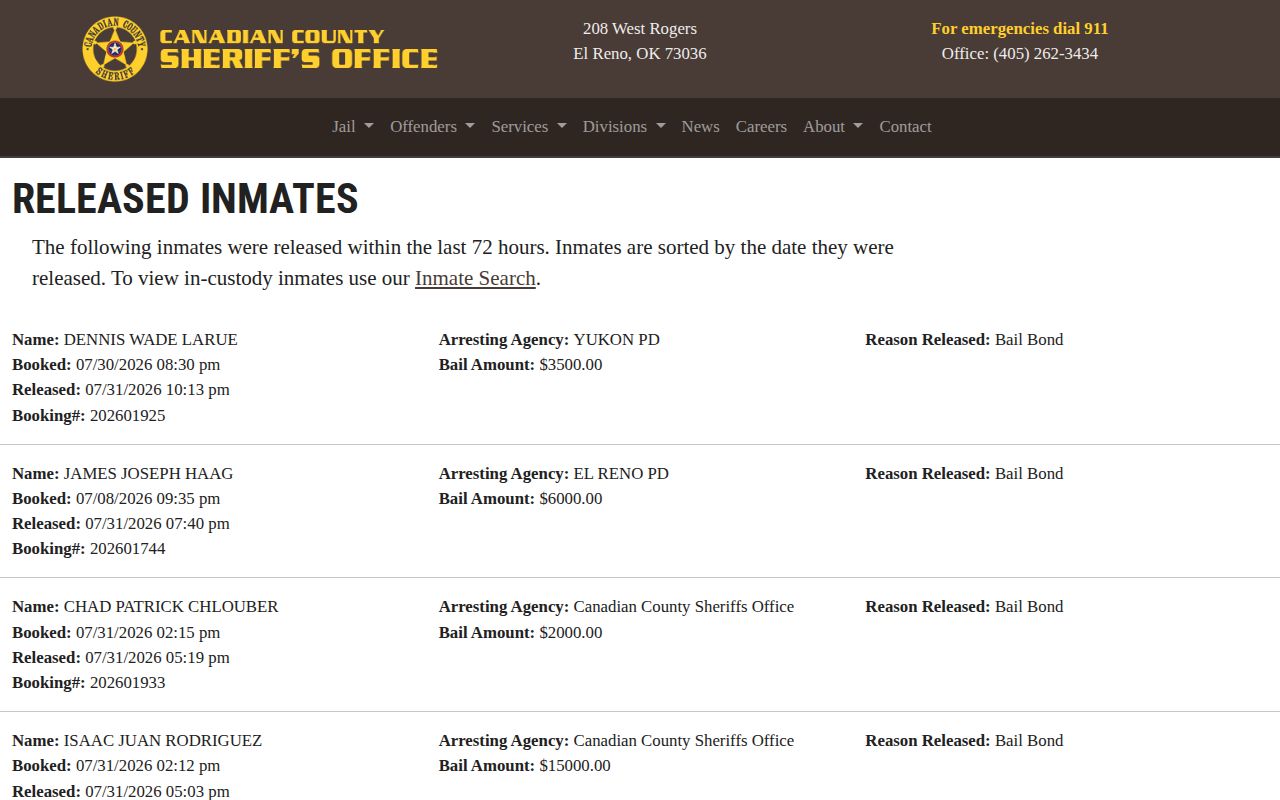
The screenshot shows why the exact timestamp and reason are the key facts for confirming a Canadian County Jail release.
Canadian County Jail Release Records
Once an entry rolls off the public page, ask the Canadian County Sheriff’s Office Records Division for an existing record. A narrow request is more useful than a request for an explanation or a custom report. Provide the person’s full name, booking number if known, and a tight date range. Request the booking and release sheet, booked and released timestamps, release disposition or reason, arresting agency, charges, and booking photograph only when that image is needed for identification or a court process.
The official form asks for a clear description, search terms, start and end dates, requester details, a purpose category, and whether the request is commercial. It rejects an open-ended request that continues into the future. Oklahoma law does not require the sheriff to create a record that does not exist. The form also warns of possible search, redaction, and media charges, requires pickup, and says produced records not retrieved within 90 days may be destroyed.
| Record field | What it establishes |
|---|---|
| Booking number | Connects the request to one jail episode. |
| Booked timestamp | Shows when CCSO recorded entry into the booking. |
| Released timestamp | Shows when the jail recorded the exit. |
| Reason released | Identifies bond, plea, dropped hold, or transfer language. |
| Arresting agency | Names who made or delivered the arrest, not necessarily the final custodian. |
Use the CCSO Records Division instructions for the current request route and posted fee terms. The office that created the record should confirm any certified or disputed fact.
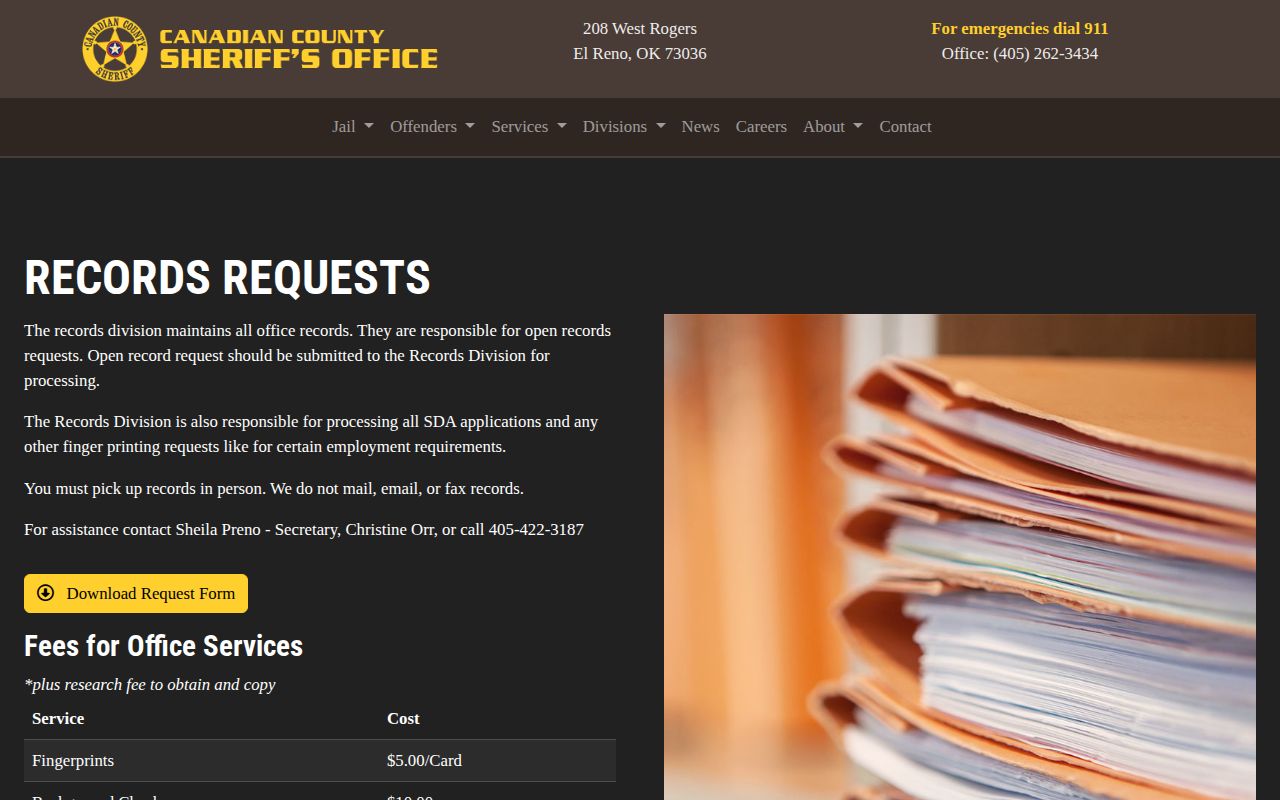
The official CCSO records page captured below is the proper fallback when the short public window no longer contains the booking.
Canadian County Jail Contact
Operational questions belong with the jail. No official source publishes a standard release hour, weekend or holiday schedule, public exit door, family waiting point, property-pickup process, local ride arrangement, county good-time formula, or guaranteed web update interval. Calling ahead is the sound route for a specific current issue. Staff can identify the right office, but a phone statement is not a substitute for a release sheet when a durable record is required.
Canadian County Jail304 N. Evans
El Reno, OK 73036
Jail: 405-422-3188 Canadian County Sheriff’s Office
208 W. Rogers
El Reno, OK 73036
Main office: 405-262-3434
The official detention page identifies Major Kristie Carter as jail administrator and lists carterk@ccsheriff.net. Use that published contact only for matters within the administrator’s role. Records requests should still follow the Records Division process.
Note: Confirm current procedures by phone because the researched sources do not publish release hours, pickup steps, or a public waiting area.
Canadian County Jail Release History
The official detention-center page states that the facility has 194 beds. Its historical account says the jail averaged about 300 people per day and processed roughly 4,000 people in 2017. Overflow was then housed in Grant, Dewey, Washita, Ellis, and Pottawatomie county facilities. Those figures describe 2017 only. They do not establish present population, current contracts, or a current annual release count.
The historical detail still explains a key release-search problem. A person can vanish from one current roster because the jail moved that person. That absence alone does not prove a community release. The official jail information screen below identifies the source of the capacity and historical details.
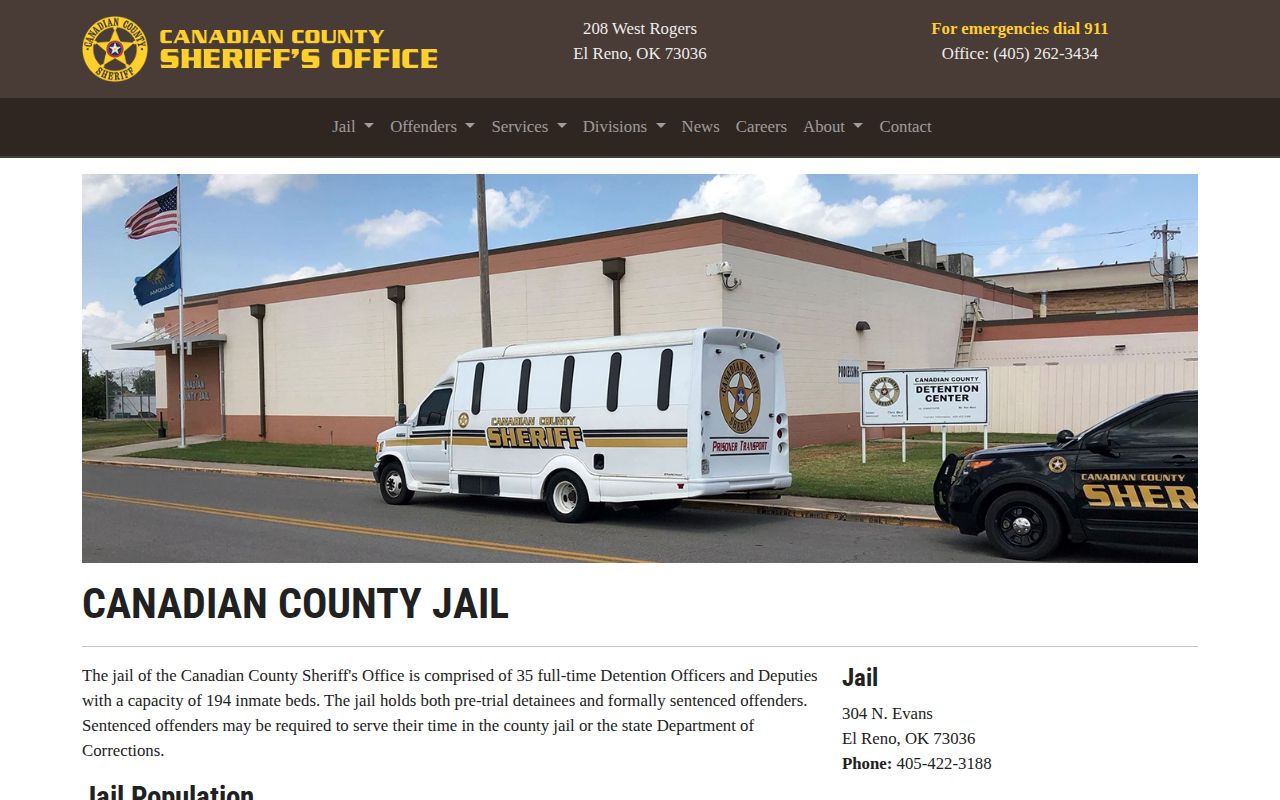
Reading the facility facts with the release reason prevents an old overflow pattern from being mistaken for a current release statistic.
Canadian County Jail ICE Transfers
Canadian County has a formal ICE 287(g) jail-enforcement memorandum. It documents a supervised partnership for identifying and processing certain people in CCSO jail facilities. It does not, by itself, establish that Canadian County Jail is an ICE contract detention center. That distinction matters when a release line or roster change is being interpreted.
An immigration detainer asks a jail for advance notice and requests that custody be held for up to 48 hours so ICE may assume it. If a Canadian County Jail record reflects a handoff, check the receiving authority rather than treating the jail exit as community return. ICE’s Online Detainee Locator can include people in ICE custody and some people released from ICE custody within 60 days, but upload delay and coverage limits make a no-match inconclusive.
A county record and an immigration result answer different questions. The first documents the CCSO episode. The second may document later ICE custody or release. Preserve both dates and agency names when they differ.
Canadian County Post-Release Rule
Canadian County has a distinctive facility-access rule after release. The sheriff’s mail and visitation policy says a person who was incarcerated at the jail may not visit or correspond with a current inmate for six months after the former person’s release date. This is a local access restriction tied to the recorded date. It is not a statement about how long the release entry stays online.
That rule gives the release timestamp a practical use beyond confirming the custody change. A person planning contact with someone still housed at Canadian County Jail should use the actual release date and ask the jail how the rule applies. Do not infer an eligible visit date from a court order alone, since court authority and physical jail processing may occur at different times.
The six-month period also shows why source terms must remain separate. The web page’s 72-hour window describes public display. The visitation rule describes access after a person’s actual release. Agency record retention is a third issue, and no CCSO archival period was found in the research. A release entry rolling off the web does not erase the underlying booking event. Request the existing jail record when the date is no longer visible, then use that confirmed date for a facility-access question.
The source image below comes from the official visitation and mail page.
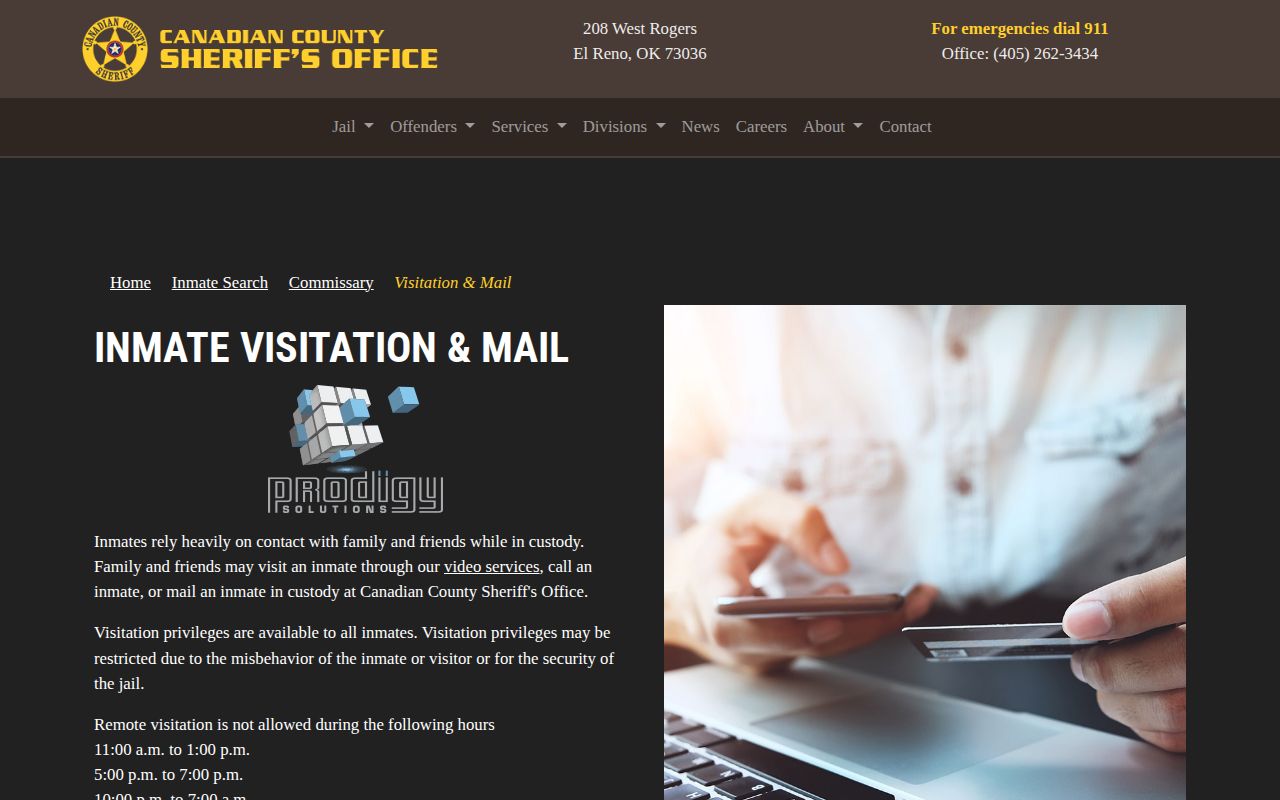
The published six-month restriction makes a confirmed Canadian County Jail release date important for later facility contact.
Note: The visitation restriction does not extend or define the sheriff’s rolling 72-hour public release window.