
Canadian County Juvenile Release Privacy
Canadian County Juvenile Detention Center is a secure county juvenile facility within the Gary E. Miller Children’s Justice Center. Its presence in the local facility map does not create an adult released-inmate record. Juvenile confidentiality takes priority. The Canadian County Sheriff’s public 72-hour list, the adult current roster, ODOC adult offender search, BOP locator, adult registries, and public mugshot channels should not be used to reconstruct a young person’s detention or release.
Absence from an adult tool carries no meaning about juvenile custody. It does not establish that a youth was never detained, remains detained, transferred, or was released. Likewise, the appearance of a similar name in an adult record should not be connected to a juvenile. The correct route depends on legal authority and relationship to the child, not public curiosity.
Juvenile Center Records Contact
The researched local page identifies the facility within the Gary E. Miller Children’s Justice Center. It does not publish an adult-style release inquiry line or public custody archive. The proper contact depends on the person’s lawful role and the case. An authorized requester should begin with the responsible court or agency rather than asking the sheriff’s adult records division to produce a juvenile release list.
Canadian County Juvenile Detention CenterGary E. Miller Children’s Justice Center
7905 E. Highway 66
El Reno, OK
The official Canadian County juvenile detention page confirms the facility and describes its secure detention function.
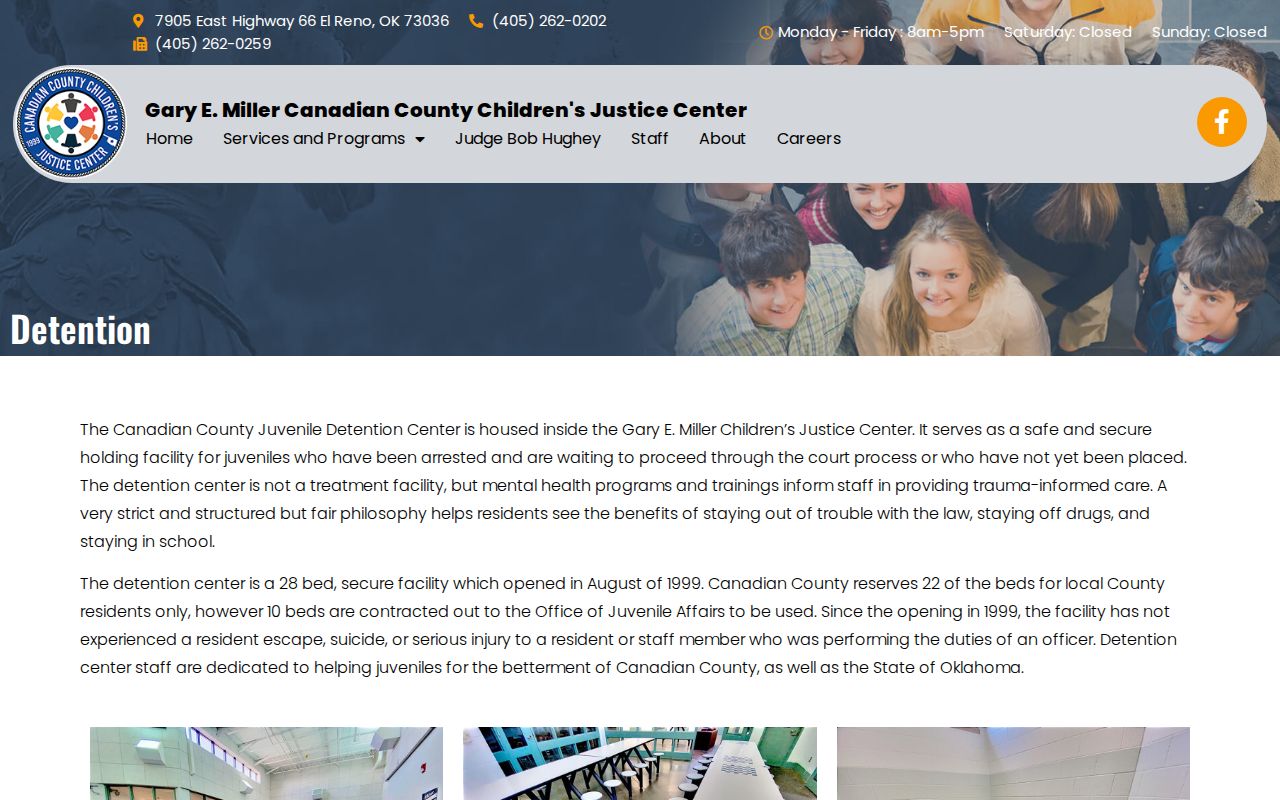
The facility page provides institutional context, not a public list of juvenile identities or release events.
Keep contact focused. Do not ask staff to confirm a juvenile to someone who lacks authority. Do not share names, dates of birth, case details, or images in a public forum while trying to locate the right office.
Juvenile Detention Center Facts
The local source describes a 28-bed secure facility opened in 1999. Those are facility facts, not current population or release statistics. They should never be used to estimate how many young people are held, when a person may leave, or whether a named child has been there.
The Oklahoma Office of Juvenile Affairs detention-center list is another official facility-level source.
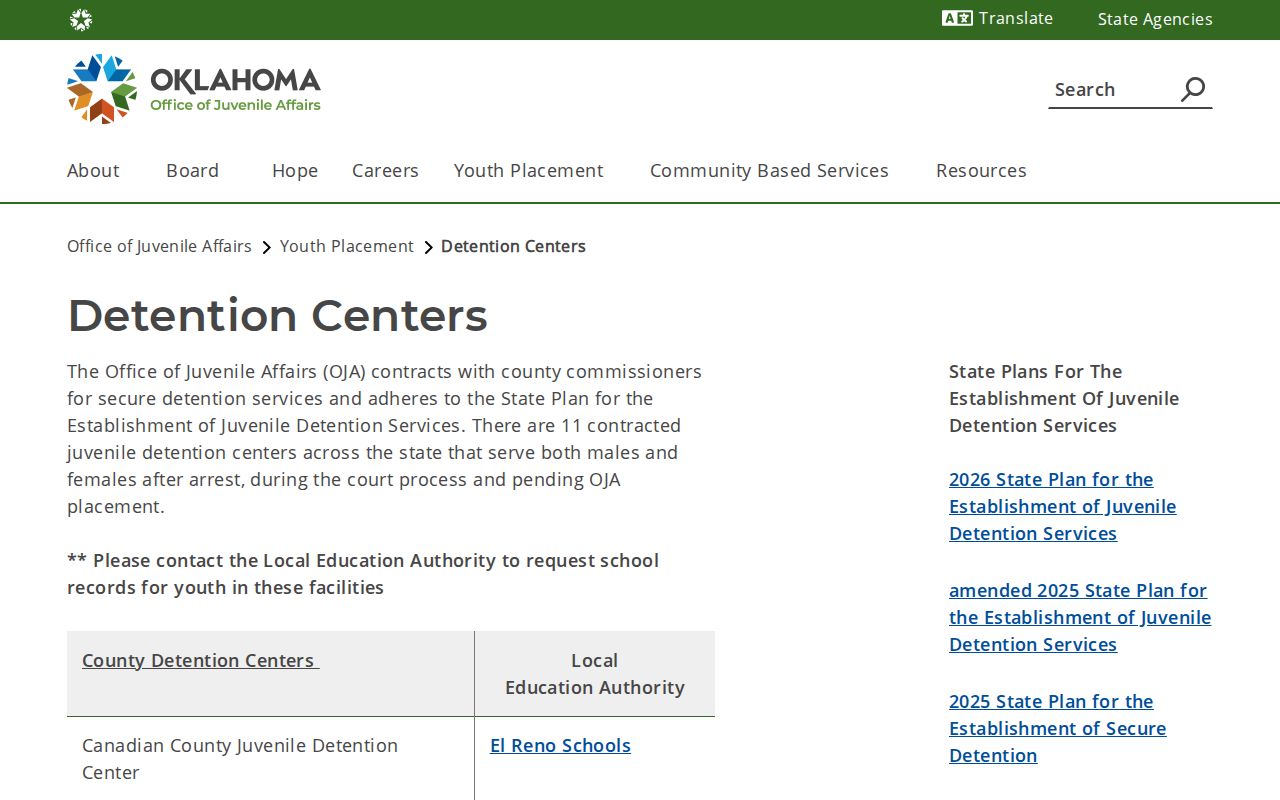
The state list confirms the detention-center network while preserving the line between facility identification and confidential youth information.
Juvenile Records Versus Adult Tools
Each public adult tool has a defined scope. The sheriff’s current roster shows adults then displayed in county custody. Its released page shows county-jail departures within a short rolling window. ODOC covers people committed to adult state corrections. BOP covers federal prisoners, and ICE’s locator expressly excludes minors. None is an alternate door into Canadian County juvenile information.
| Adult source | Why it does not answer juvenile release |
|---|---|
| CCSO current roster | Current adult county-custody display, not a juvenile locator. |
| CCSO 72-hour releases | Adult county-jail release feed, not juvenile history. |
| ODOC lookup | Adult state corrections locator. |
| BOP locator | Federal prison record system. |
| ICE ODLS | Immigration locator that excludes minors. |
The distinction also prevents false identity matches. A name, family link, arresting agency, or geographic connection is not enough to connect a public adult record with a youth. Confidentiality does not weaken the record system. It changes who may obtain information and by what process.
Juvenile Release and Immigration Limits
Canadian County’s CCSO 287(g) memorandum applies to jail-enforcement work in sheriff facilities. It should not be used to infer that a juvenile at the Children’s Justice Center entered ICE processing. ICE also states that its public Online Detainee Locator excludes minors. These limits take precedence over the general facility-page detainer angle.
If an authorized juvenile case involves immigration issues, the child’s lawyer, court, guardian, and responsible agency must use the protected case process. A public adult locator is not a fallback. A no-match reveals nothing, and an adult record involving a relative must not be treated as evidence about the youth.
This is one point where the custodian-first rule is not enough by itself. The requester must also have lawful authority. Both requirements should be satisfied before any case-specific information is sought or shared.
Juvenile Facility History Matters
Canadian County has several institutions that can be confused because they sit near El Reno or Union City. The juvenile center opened in 1999 as a 28-bed secure facility. Separately, the building now used by UCCCC began as an Avalon high-security juvenile facility in 1999 before becoming an adult ODOC community-corrections center. These are not the same present-day operation.
Historical descriptions can outlive an agency change. A source that calls the UCCCC property a former juvenile facility does not make current UCCCC records juvenile records. In the same way, the current Canadian County Juvenile Detention Center should not be placed in the adult ODOC, BOP, or CCSO release paths simply because those systems also operate in Canadian County.
Name the current operator and current purpose before choosing any record route. For the juvenile center, stop at facility-level public facts unless an authorized court or agency process permits more. No screenshot of a juvenile record should be sought, saved, or published.
Safe Juvenile Release Inquiries
A safe inquiry contains only what the authorized office needs. Start with the case contact already supplied to the parent, guardian, lawyer, or other lawful participant. Do not post a youth’s name on social media, send it to an adult roster site, or ask unrelated agencies to search broadly. If the caller reaches the wrong office, ask which authorized channel handles the matter without sharing case details first.
Timing should be handled with the same care. A hearing, placement decision, or court direction may be one step in a protected juvenile process. It should not be converted into a public release prediction. Only the responsible court or agency can explain what may be disclosed and to whom. A family member who is not the legal guardian may have different access from a parent, counsel, or court-appointed representative.
Records can also carry limits on redisclosure. Receiving information through an authorized role does not make it public. Follow the court order, agency instruction, and counsel’s advice about who may see it. When uncertain, keep the information private until the responsible authority answers.
Juvenile Release Record Boundaries
A facility address, opening year, or bed count is public institutional information. A child’s name, custody status, hearing result, placement, release date, image, and destination are case-specific facts. The first group can describe what the Canadian County Juvenile Detention Center is. The second group must remain within the authorized juvenile process. Mixing the two creates an unsafe inference even when no single source states the conclusion.
The same boundary applies to court research. Public adult docket instructions for Canadian County are not an invitation to reconstruct a juvenile matter. If an authorized participant needs a court document, that person should ask the juvenile court or counsel which form, identification, order, or relationship proof is required. An unofficial screenshot or a result from an adult name search cannot replace that process.
Accuracy concerns reinforce privacy. Two people may share a name, public databases can lag, and an adult arresting-agency field may refer to someone else. A false match can expose a child and misstate a legal event at once. Stop the search when the public source falls outside its stated adult scope.
Juvenile Release Destination Privacy
Adult facility pages can often explain whether a person returned to the community, entered supervision, or transferred to another custodian. That public framework does not authorize publication of a juvenile’s destination. Placement and release planning may involve the court, guardian, attorney, treatment provider, or another responsible agency, but the researched public sources do not establish a public reporting route for those facts.
An authorized family member should follow the instructions received from the case team. Travel, pickup, contact, and timing questions belong in that protected channel. Outsiders should not call nearby adult jails to infer movement, watch public rosters for a surname, or use VINE as a substitute. The absence of a public adult record is the expected result, not a gap to work around.