
Canadian County's Official 72-Hour Releases
The Canadian County Sheriff's released-inmates page expressly covers people released within the last 72 hours. It is sorted by release date and is the only official recent-release window documented by CCSO. The source does not publish an update cadence or promise real-time changes. Treat it as an active rolling view, not a permanent archive.
Unlike the current roster, this feed records an exit from Canadian County Jail custody. Yet exit does not always mean return to the community. Its Reason Released field may identify a bond, own-recognizance release, plea, dropped hold, or transfer. That last route can continue custody under another agency.
The official source capture illustrates the layout. Consult the live 72-hour list for the current records.
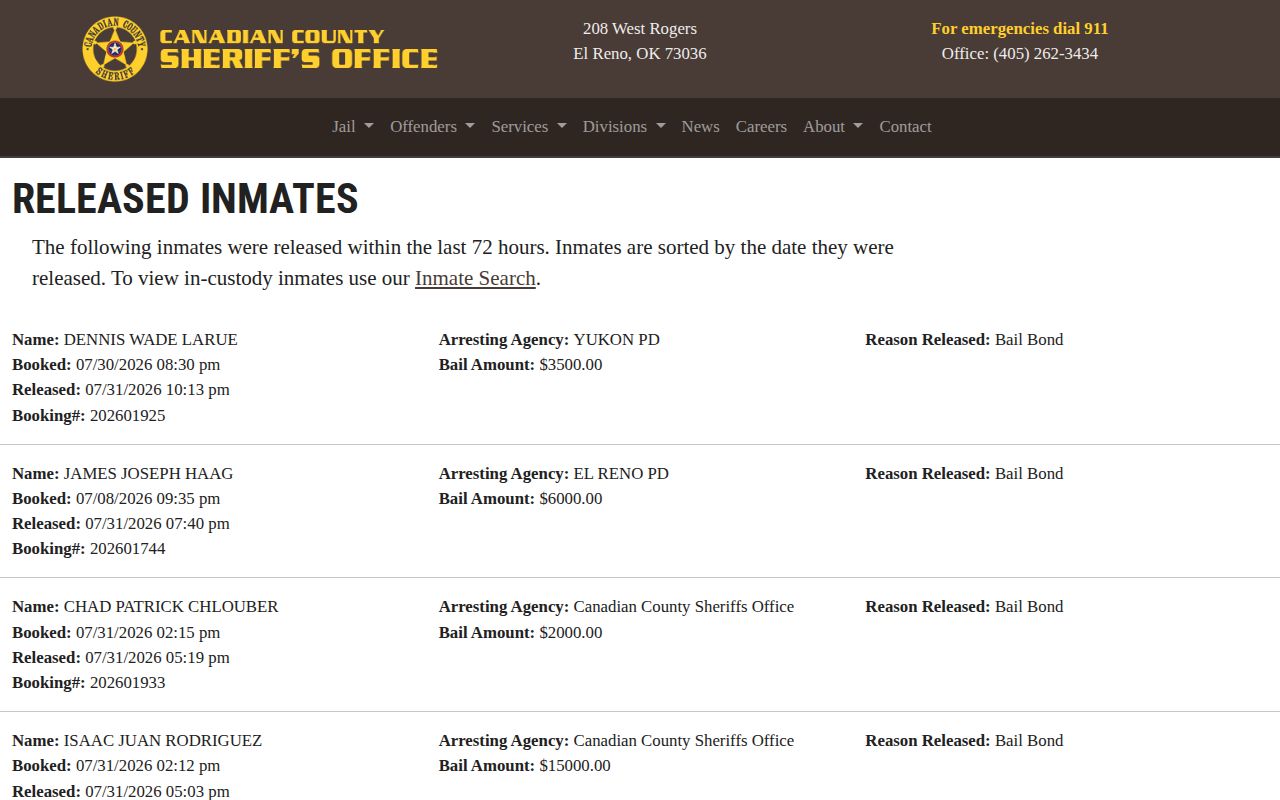
The visible timestamps make the three-day period useful for a later check, while the booking and reason fields keep the event tied to the correct custody record.
Check Canadian County 72-Hour Releases
Start at the release page and keep the access date and time. Because the window rolls, the set of names will change as older entries pass beyond 72 hours and new records appear. A saved note of when the check occurred is more useful than describing the page as a static three-day calendar.
- Open the official CCSO release page rather than the in-custody inmate search.
- Locate the full name and compare the booking number, booked time, and arresting agency.
- Read the Released timestamp to confirm that the event falls inside the rolling 72-hour window.
- Copy the Reason Released exactly, especially when it names a transfer or hold event.
- Use the court docket or receiving custodian to explain what happened before or after the jail exit.
For only the preceding day, use the Canadian County 24-hour release method and filter these same timestamps. Do not take the first screen of results or the current calendar date as a substitute for time comparison.
When identity is uncertain, use more than a name. The booking number is the strongest identifier on the CCSO line. Dates and arresting agency can separate two similar names. A careful finding states which fields matched and when the source was viewed.
Canadian County 72-Hour Release Fields
The CCSO view contains a compact custody event rather than a full case file. Its fields answer who was booked, when that booking began and ended, which agency made or delivered the arrest, and why county custody ended. Charges and photographs are not part of this released layout.
| Field | What it establishes |
|---|---|
| Name | The person named in the county booking and release entry. |
| Booked date and time | The start timestamp displayed for that booking. |
| Released date and time | The recorded end of CCSO custody and the basis of the rolling window. |
| Booking number | A county identifier used to match records and write a focused request. |
| Arresting agency | The agency tied to the arrest, not necessarily the next custodian. |
| Total bail | The displayed bail figure, which does not by itself settle the case result. |
| Reason released | The recorded disposition of the CCSO custody event. |
The page offers no charge panel, mugshot, or booking-profile link. If a charge or judgment matters, use the Canadian County OSCN docket. If an image matters, request the existing booking photograph from CCSO Records. Neither gap should be filled with a guess from a third-party page.
Note: The sheriff describes a 72-hour public display window but does not publish the underlying agency retention period on that page.
Canadian County Weekend Release Checks
The three-day view is most helpful when a check could not be made each day. A Monday review may still contain qualifying Friday, Saturday, or Sunday entries, depending on the exact time of each release and the time of access. The timestamp decides inclusion. The day name alone does not.
No official Canadian County source documents a standard release hour, weekend schedule, Friday-early-release practice, holiday adjustment, public exit door, or processing time. Do not promise when someone will walk out. A court order may authorize release before detention staff complete identity checks, property steps, paperwork, and a search for other holds. The page's event time records the jail result after processing, not an estimate based on the docket.
A release authorized late in a holiday period may also be recorded after an earlier court event. Conversely, a release entry may show a transfer rather than a trip home. For a time-sensitive pickup or legal question, call the Canadian County Jail at 405-422-3188 and ask only about the specific operational point the jail can confirm.
Canadian County Release Reason Meanings
The sheriff's exact labels should be preserved because each describes a different exit route. `Bail Bond`, `Cash Bond`, and `Own Recognizance` can end the jail stay while the criminal case continues. `ENTERED PLEA` signals a court development but does not disclose the full judgment or sentence. `HOLD DROPPED` describes a hold event and cannot settle whether another basis for custody remained.
- Community-facing route
- A bond or own-recognizance line may show how CCSO custody ended, subject to any other hold.
- Court-linked route
- An entered plea must be reconciled with the OSCN docket and judgment.
- Transfer route
- `TOT OTHER AGENCY` means another authority received custody.
- Unclear later status
- Use VINE, ODOC, BOP, ICE, or another jail based on the named custodian and known case facts.
The arresting-agency field is not the same as the releasing facility. El Reno Police, Yukon Police, Mustang Police, Oklahoma City Police, and other agencies can appear on a CCSO booking. The Canadian County Detention Center is still the facility feeding this page.
Canadian County Transfers After Release
Canadian County's custody landscape includes county, municipal, state, and federal systems. A person can leave CCSO custody and remain confined elsewhere. ODOC operates the Union City Community Corrections Center. The Bureau of Prisons operates FCI El Reno. Yukon has its own municipal jail, and an immigration detainer can produce a separate federal handoff.
The CCSO Civil Division lists ODOC, warrant, court-order, extradition, and juvenile transports among its duties. That official description shows why movement between custodians is ordinary.
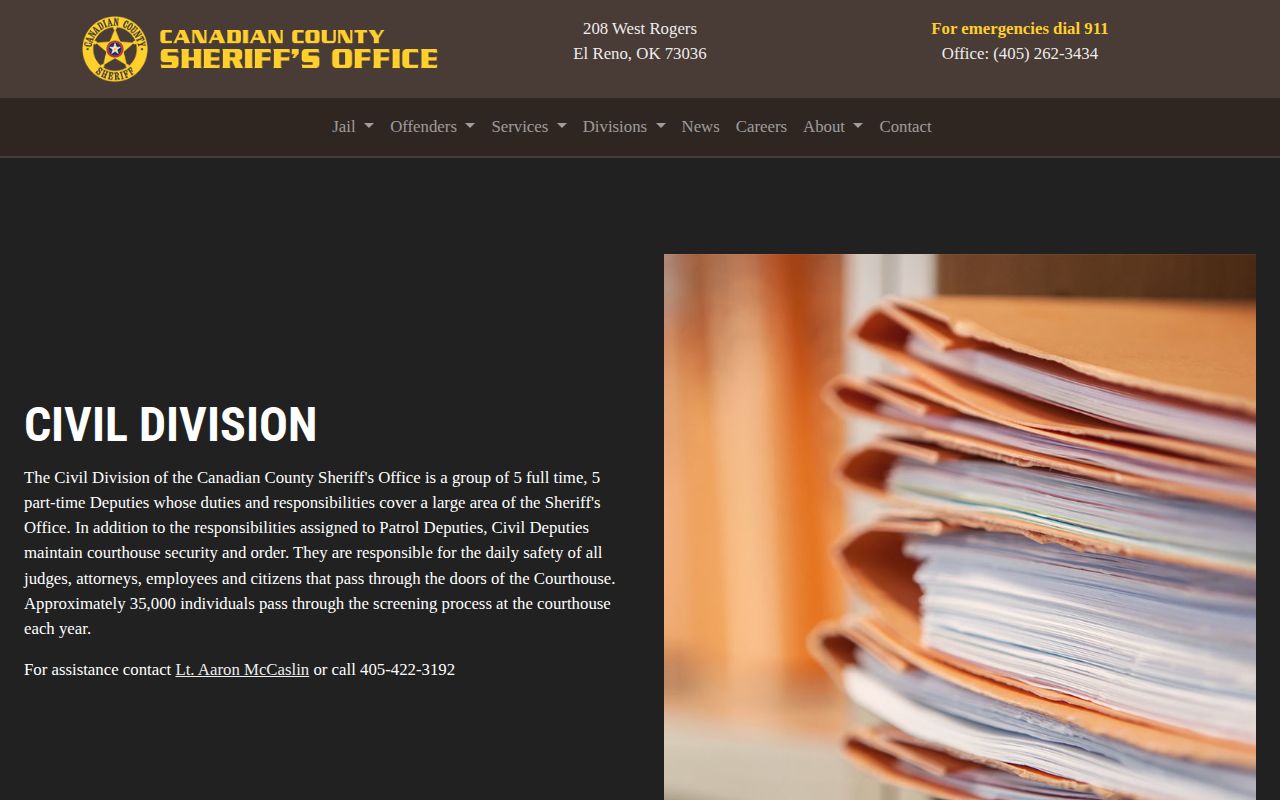
A transfer line ends the county-jail episode but begins the next verification task. Search the receiving system and keep the CCSO booking number as the link back to the county event.
Canadian County Releases Beyond 72 Hours
Once an entry rolls off the page, request the existing booking and release sheet from CCSO Records. Supply the full name, booking number if known, and a finite date range. Ask for the booked timestamp, released timestamp, arresting agency, and release reason. This focuses the search on records the agency already maintains and avoids asking staff to create a custom report.
The Records Division is at 208 W. Rogers, El Reno, OK 73036. Its published phone is 405-422-3187, email is orrc@ccsheriff.net, and fax is 405-422-2430. The form permits email submission, but the sheriff states that produced records must be picked up in person. It lists $0.25 per copy page and $20 per research hour. Search or redaction costs can depend on scope, and staff seeks authorization before conducting a fee-bearing search.
OSCN can preserve the court disposition long after the short sheriff window closes. It proves docket events, not the physical release timestamp. VINE may provide current status and alerts, but it is not a certified historical archive. ODOC records are required for a state transfer, and BOP or ICE tools serve their own federal custody systems.
If no recent entry appears, the Canadian County named-person release search helps choose the right custodian. Yukon City Jail has no published released-person archive in the researched material. UCCCC is an ODOC community-corrections facility, not a county jail, and FCI El Reno is federal. Juvenile detention records are confidential and do not belong in an adult lookup. Sorting those systems first avoids treating a valid no-result from the sheriff feed as proof that no custody or release event occurred.
Note: A person absent from both the live roster and the release feed may have an older event, another custodian, a data mismatch, or sealed material.
After a Canadian County Release
Canadian County Jail publishes an unusual access rule tied to the recorded release date. Its mail and visitation rules state that a person incarcerated there may not visit or correspond with a current inmate for six months after the former person's release.
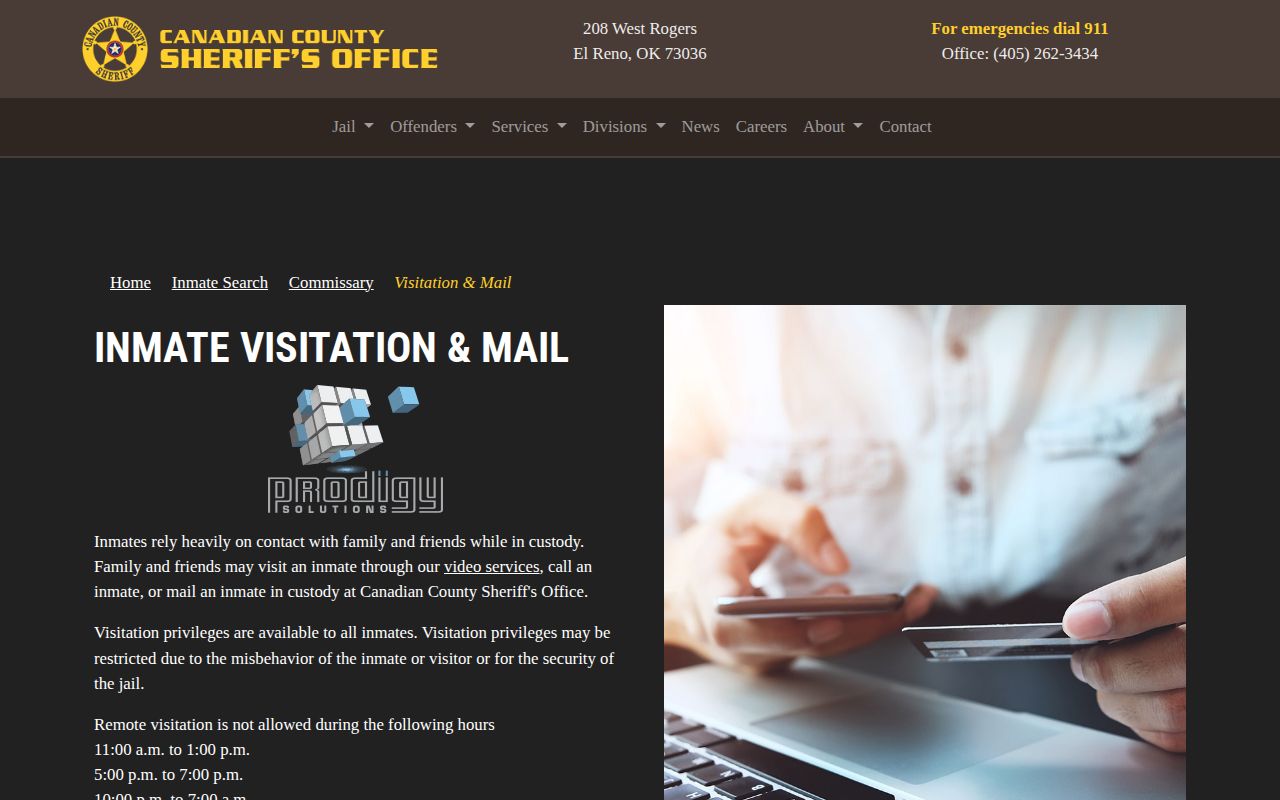
This is a facility-access consequence, not a rule that the web release entry stays online for six months. The public feed still states only a rolling 72-hour period. Anyone affected should read the current jail rules and ask the facility about how they apply before attempting a visit or correspondence.