
Canadian County Release Mugshot Sources
Canadian County does not publish a released-inmate photo gallery. The sheriff's current inmate-search interface contains a mugshot area on booking cards, but the office defines that roster as the in-custody population. A photo there links the person to the displayed current booking. It should not be used as proof that the person has been released.
The separate CCSO 72-hour release page has no photograph, charge panel, profile link, or stored booking page in its public layout. It shows the custody event through name, booking number, booking and release timestamps, arresting agency, bail, and reason. Those fields can identify the precise booking photo to ask for, even though they do not display the image.
The official roster capture shows the source context and mugshot area. View the live roster for current custody only.
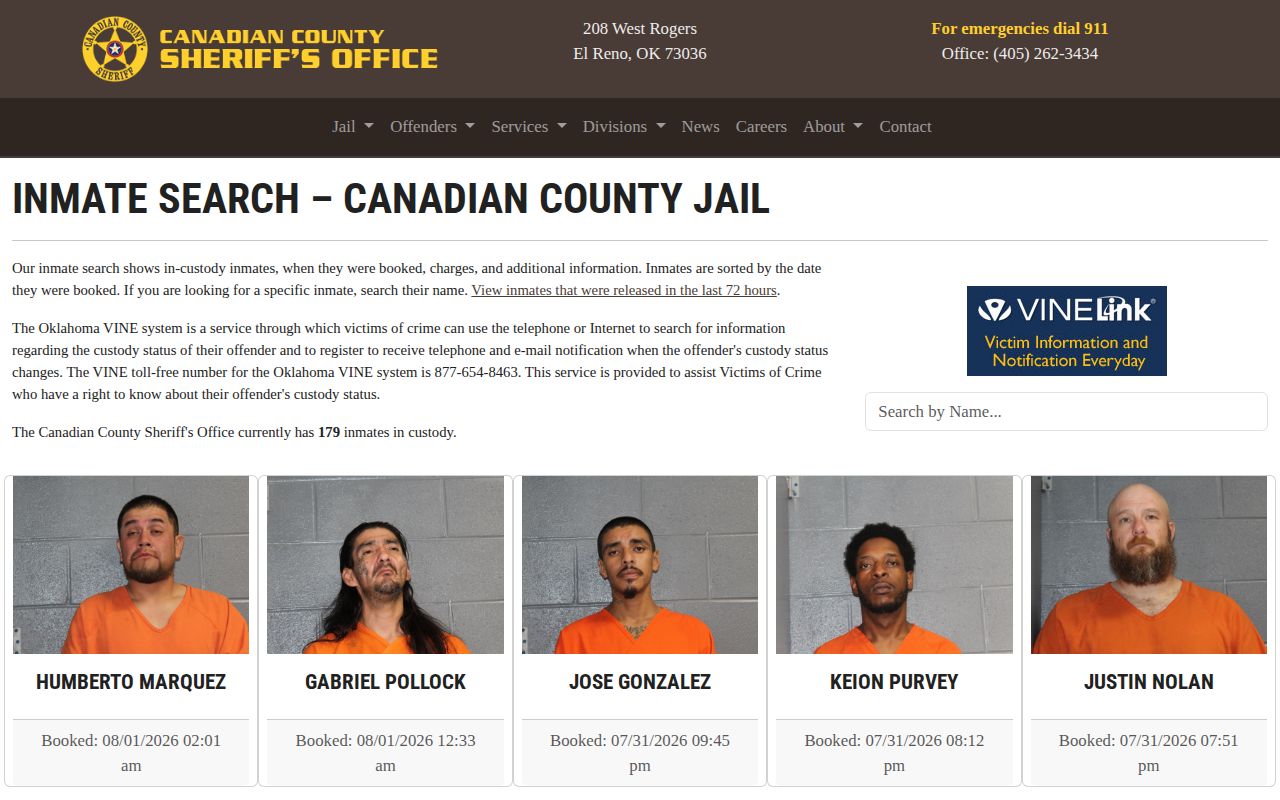
A person missing from that roster may have been released, transferred, moved to another custodian, omitted by an update, or affected by a sealed record. Confirm the release separately.
Where Canadian County Release Photos Appear
Each photo channel proves a different fact. Match the image to the agency and record that created it before drawing any conclusion about identity, custody, or release.
| Channel | Has a photo? | How to access and interpret it |
|---|---|---|
| CCSO current roster | Usually a photo area | Search the live in-custody roster. It is not a released gallery. |
| CCSO 72-hour release feed | No | Use the booking number and timestamps to identify the record for a photo request. |
| CCSO records request | May provide an existing booking photo | Ask narrowly by name, booking number, and dates, subject to exemptions and actual retention. |
| Official sheriff app | Not verified | The apps exist, but official web material does not confirm a mugshot or release feature. |
| ODOC offender lookup | Commonly | An offender image belongs to state correctional custody, not necessarily the county booking. |
| Sex and violent offender registry | For covered registrants | A registry photograph reflects a statutory registration duty, not a universal release list. |
| Official news or social post | Sometimes | Selected case imagery is episodic and must retain its original date and context. |
BOP and ICE locators are status tools and should not be presented as mugshot sources. Commercial aggregators may retain stale, incorrect, or monetized images and cannot prove release. Canadian County has a direct official recent-release source, so no commercial photo page is needed to verify the custody event.
Note: A county booking image, an ODOC offender photo, and a registry image can depict the same person while documenting different government records.
Request a Canadian County Booking Photo
The reliable path for a past county booking image is a narrow request to the Canadian County Sheriff's Office Records Division. Ask for the existing booking photograph associated with one identified booking. A request for a custom gallery, explanation, or indefinite future production asks for something the office may not maintain. Under 51 O.S. §24A.18, an agency need not create a nonexistent record.
- Use the official CCSO open-record request form and enter the requester's required contact details.
- Identify the person by full name and booking number when known. Add a finite booking and release date range.
- Ask for the existing booking photograph and associated booking/release sheet, including the recorded timestamps and disposition.
- Submit the form to orrc@ccsheriff.net or use the listed Records Division return methods.
- Review any search, redaction, copy, or media estimate before authorizing work, then arrange the required in-person pickup.
The Records Division is at 208 W. Rogers, El Reno, OK 73036. Its phone is 405-422-3187 and fax is 405-422-2430. CCSO states that records produced through this process are picked up in person, not mailed, emailed, or faxed. The posted schedule lists $0.25 per copy page, $20 per research hour, and $5 for a USB used for audio or video. Those figures do not guarantee a fixed photo-request total.
The office may withhold or redact a photo when a lawful restriction applies. The request route also cannot guarantee that every historical image was retained. If records become available, the form warns that produced material not retrieved within 90 days will be destroyed. That pickup deadline is not the same as the agency's retention period.
Match Canadian County Photos to Releases
A photograph identifies the booking context only when it is tied to the correct record. First locate the person's release entry, then carry its booking number and exact dates into the photo request. This avoids mixing a current card, an older arrest, and a state correctional image belonging to different events.
| Record | Question answered | What it does not answer |
|---|---|---|
| County booking photo | Which image the sheriff tied to a named booking. | Whether the charge resulted in conviction or how the case ended. |
| 72-hour release line | When and why CCSO custody ended for that booking. | Whether another agency then held the person. |
| OSCN docket | Court events such as bond, plea, disposition, and judgment. | The exact time jail staff completed release. |
| ODOC record | State custody, community status, identifiers, and state offender image. | The contents of the county sheriff's booking file. |
`TOT OTHER AGENCY` in the county release reason means the person was transferred. The county booking photo can remain the correct image for that earlier arrest, while ODOC, another jail, BOP, or ICE controls the next custody status. A bond entry can also leave the criminal case open. The Canadian County same-day release method explains how to filter the sheriff's timestamps without inventing a separate feed.
ODOC Photos After Canadian County Release
The ODOC Offender Lookup commonly displays an offender photograph with a name, DOC number, identifiers, custody location or status, and sentence information. That photograph belongs to an Oklahoma Department of Corrections record. It may help distinguish people with similar names after a transfer to state custody, but it cannot prove that the same image came from the Canadian County booking.
A community correctional location can still mean ODOC custody. Union City Community Corrections Center is a local state facility, and authorized work or activity outside its secure setting is not full discharge. Parole also means community supervision rather than the end of every state obligation. When final state disposition matters, request the Certificate of Release or Notice of Inmate Status Change through ODOC Offender Records and Registries.
The Oklahoma Sex and Violent Crime Offender Registry may display a current registration photograph for a person who has a statutory duty to register. It is not a list of all Canadian County released inmates. Absence from that registry says nothing about most people who have left custody, and a registry photo should retain its registration context.
Canadian County Sheriff App Photo Limits
CCSO links official mobile applications in both major app stores. However, the agency website does not document that the apps display recent releases or mugshots. The presence of an official app should not be turned into a claim about an unverified feature. The web roster is the confirmed current-photo channel, and a records request is the confirmed route for an existing past booking image.
The official Apple listing verifies the app's identity.
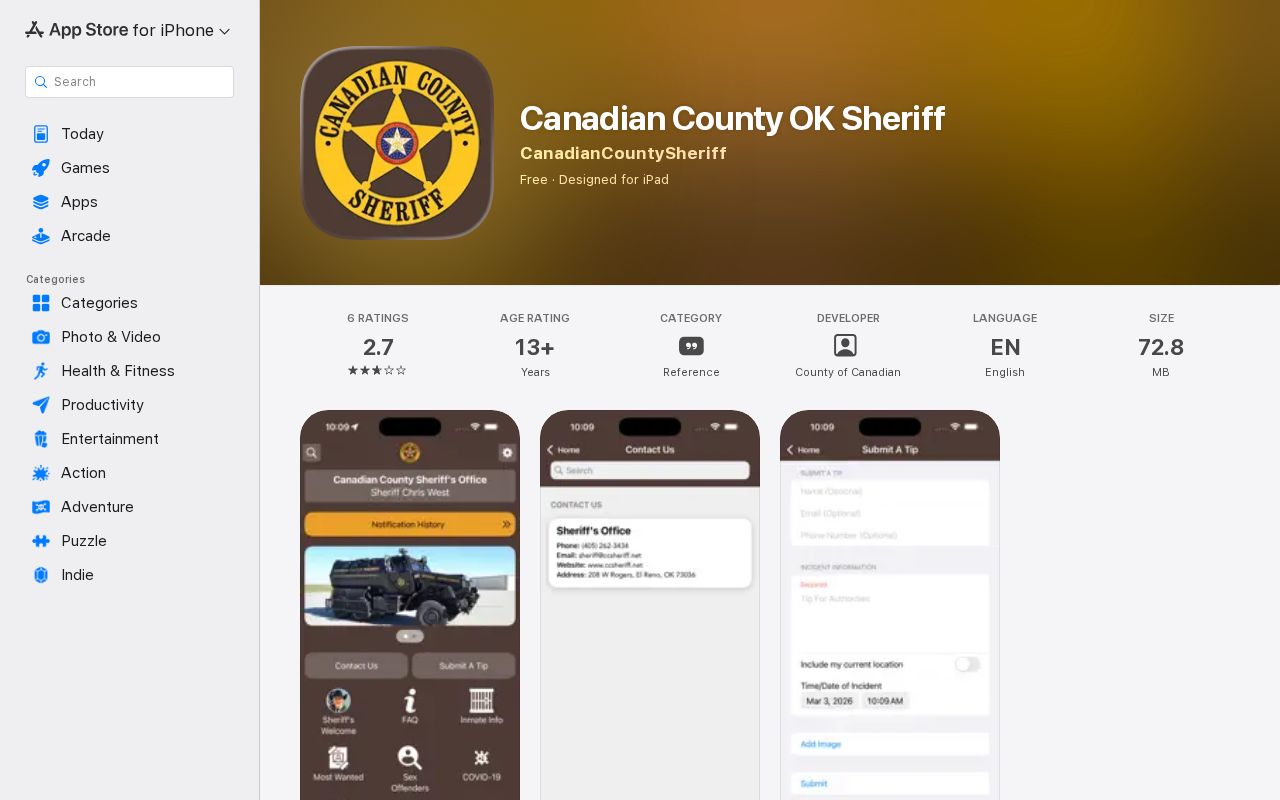
A live app screen would need to be checked before saying that a release or booking-photo function exists. Until then, the app is an additional official agency channel, not an established mugshot archive.
CCSO news and official social posts can contain arrest or case images in selected public-interest matters. These posts are episodic. They do not represent every arrest or release and should never be converted into a comprehensive index. Keep the original report, date, and context with any image used to understand a public case.
Oklahoma Law and Release Mugshots
The Oklahoma Open Records Act, 51 O.S. §§24A.1 through 24A.31, provides the access framework for existing nonexempt records. Section 24A.8 addresses specified law-enforcement records, but the research did not identify an official statewide rule declaring every booking photo categorically open. Juvenile files, sealed or expunged matters, protected identifiers, safety concerns, and other lawful limits may restrict access.
No reliable official statewide anti-pay-to-remove mugshot statute was found in the research. It would therefore be inaccurate to announce that Oklahoma either has or lacks such a rule based on a commercial summary. The sound statement is agency specific: the CCSO current roster includes a photo area, the released feed does not, an existing county booking photograph can be requested, and ODOC may show its own offender image.
A photograph can outlast the short web release window without proving present custody. Conversely, a lawful sealing order can make an old public path disappear. Treat current agency responses as controlling over a stale copied image.
Expunged Canadian County Booking Photos
Oklahoma expungement law can change what the public may obtain. Title 22, §§18 and 19, sets fact-specific eligibility and the petition procedure. Section 19 calls for filing in the district where arrest information is located, notice to the prosecutor, arresting agency, OSBI, and other named entities, followed by judicial review. A resulting order identifies the agencies and records affected.
Qualifying categories differ. They can involve acquittal, reversal, factual innocence, pardon, declined or time-barred unfiled arrests, qualifying dismissals, and certain deferred or conviction records subject to statutory conditions. There is no sound universal waiting-period claim. Anyone dealing with a specific order should use its exact terms and the current statute.
Once covered records are sealed, the conduct may be treated as not having occurred for public response. An official no-result can therefore reflect lawful sealing rather than proof that an arrest never happened. Do not republish an obsolete image merely because a commercial page still displays it. Ask the agency that holds the record how a signed order should be submitted or reflected.
Note: Juvenile custody and release information is confidential and must not be reconstructed from adult photo, roster, registry, or news channels.
Verify a Canadian County Release Photo
Use a source sequence that keeps image, booking, and custody status separate. Identify the correct booking through the booking number and dates. Confirm the exit through the sheriff's release timestamp and reason. Use OSCN for the court outcome. Then follow another custodian only when the record supports a transfer or state, federal, or immigration link.
- Confirm that the image came from CCSO, ODOC, a registry, or a dated official news item.
- Match the person with an agency identifier and dates, not facial similarity alone.
- Read the release reason to distinguish bond, plea, dropped hold, and transfer.
- Check for a current official correction, sealing order, or later custody record.
For a broader named-person check, the Canadian County release-record search distinguishes county, municipal, state, federal, immigration, and juvenile systems. The result should state only what each official record supports. A mugshot proves neither guilt nor present location.