
Canadian County Parole Versus Probation
Oklahoma splits the work among courts, the Oklahoma Pardon and Parole Board, and the Oklahoma Department of Corrections. Parole permits a person to serve the remaining part of an ODOC confinement term in the community under set rules. The Board considers parole, but ODOC performs the day-to-day supervision. Probation usually comes from a court sentence. A suspended sentence is a conviction for which incarceration is held back while the person follows supervision terms. A deferred sentence delays final sentencing and may later be dismissed when its terms are met.
None of those outcomes means full discharge. Discharge is the end of the correctional term or supervision obligation. A person can leave the Canadian County Jail, live in Canadian County, and still have an active ODOC status. The court judgment explains the sentence, a Board record explains parole action, and ODOC shows the correctional status. Those records answer related but separate questions.
| Status | Who authorizes it | What to verify |
|---|---|---|
| Parole | Parole process and final authority | Board action, ODOC community status, conditions, and later discharge |
| Probation | Sentencing court | Judgment, supervision status, assigned ODOC unit, and court orders |
| Community corrections | ODOC placement | Current ODOC custody or location; this is not full discharge |
| Discharge | Completion under the controlling term | Certificate of Release or Notice of Inmate Status Change |
Verify Canadian County Supervision
Begin with a firm identity match. The ODOC Offender Lookup accepts a DOC number or name. Compare identifiers, location, and sentence details before using the result. A probation or parole office, community placement, or other community label can mean supervision is active even though the person is not inside a prison. ODOC warns that its public data are abbreviated, so a result is a locator rather than a full sentence audit.
For parole, the PPB dockets and results archive can add the decision history. Match the DOC number, then read the parole-eligibility date, projected release date, and Board Action as separate fields. Eligibility means the person may be considered. A recommendation, vote, denial, deferral, or detainer action is not proof of a physical release. Final verification comes from ODOC status and, when needed, the named release or status-change record.
- Search ODOC by DOC number when it is known; otherwise use the full name and compare identifying details.
- Read the status and location together. Note whether the record points to prison, community corrections, probation, parole, or discharge.
- If parole is involved, locate the matching PPB result and copy its exact Board Action wording.
- Check the Canadian County judgment through the OSCN court docket when probation or the sentence terms are unclear.
- Ask ODOC for the Certificate of Release or status-change notice when a final documented answer is required.
The full route for finding someone after a jail release, including county, court, state, federal, and immigration sources, is set out on the Canadian County released-inmate search.
Canadian County Parole Decision Records
The Pardon and Parole Board evaluates parole and publishes decision material, while ODOC holds the offender file and supervises a person after release. That division matters. An official Board Action table may show name, DOC number, Canadian County, case number, sentence facts, PE Date, PRD, and the action taken. PE Date is the first parole consideration point. PRD is a projected release date. Neither field, by itself, records the moment a person left custody.
Oklahoma parole eligibility is governed in material part by 57 O.S. §332.7. The result depends on such facts as the offense date, sentence, exclusions, and applicable restrictions. It should not be estimated from a charge name. If an older Board record is no longer online, use the PPB open-records request with the name, DOC number, meeting month, and exact document sought. Send requests for the offender file to ODOC and requests for the judgment to the court that owns each record.
The official PPB parole and revocation process gives the best visual context for those decision stages.
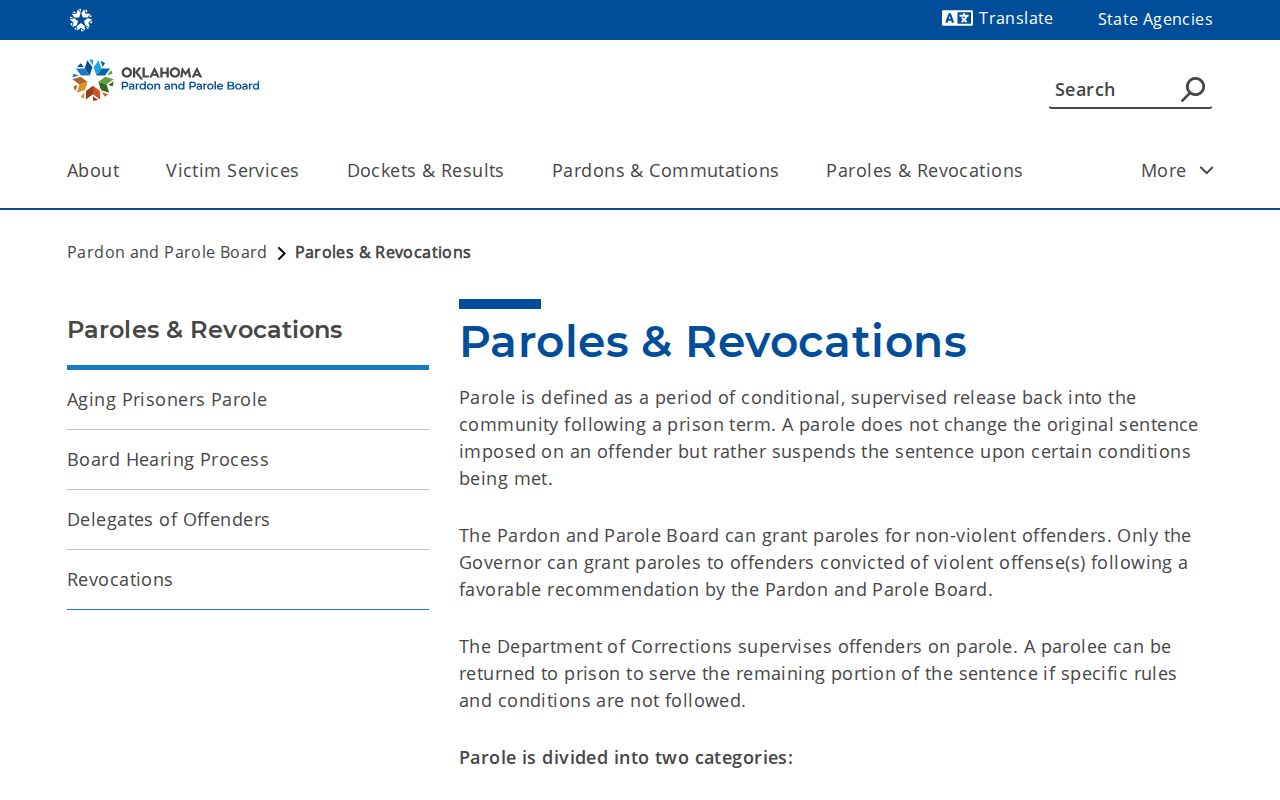
The agency page reinforces why a parole decision and ODOC supervision status must be read together before drawing a conclusion.
Canadian County Supervision Contacts
ODOC is the supervising agency for Oklahoma parole and probation. The assigned field unit can vary with the person’s residence, placement, and individual case. Start with the public offender record, then ask ODOC to identify the correct unit rather than assuming that the closest building owns the case. The supervising officer is the source for reporting terms and a current discharge date.
Oklahoma Department of Corrections
Offender Records and Registries
Closed Records: 405-425-2691
General records: osor@doc.ok.gov
Discharges only: osordischarges@doc.ok.gov
The Oklahoma Pardon and Parole Board is at 4345 N. Lincoln Blvd., Suite 1082, Oklahoma City, OK 73105, with a main number of 405-521-6600. Use PPB for parole decisions and Board records, not for an ODOC supervision file. For a Canadian County probation judgment or later order, use the Canadian County Court Clerk and the OSCN docket.
Note: Confirm current routing with the official office before travel because phone lines, office assignments, and public hours can change.
Canadian County Supervision Warrants
A supervision violation is alleged noncompliance with one or more case-specific terms. An absconder is a person whom the supervising agency reports as having stopped required contact or whose whereabouts are not known. A warrant tied to that status shows unresolved supervision. It does not mean supervision ended, and it should not be read as a new conviction. Court and agency action determine the next step.
ODOC publishes Fugitive Warrants Division contacts at 405-425-2570 and 405-425-2571, toll-free at 866-363-1119, and by email at warrants@doc.ok.gov. Do not approach a person based on a warrant entry. Send information to law enforcement and ask the issuing agency to confirm current status. The Canadian County Sheriff’s Most Wanted page warns that its entries may not be current, which is another reason to verify before treating a web listing as live.
- Absconder
- A person reported as no longer keeping required contact with supervision.
- Detainer
- A request or hold from another authority that can affect custody or release.
- Revocation
- A formal process that may withdraw parole or probation after an alleged violation.
- Discharge
- The documented end of the correctional term or supervision obligation.
Canadian County Community Corrections
Union City Community Corrections Center gives Canadian County an important local distinction. UCCCC is an ODOC community-security facility with work-release, reentry classes, and transitional programming. A resident may leave the secure setting for approved work or an authorized activity yet remain in ODOC custody. That is not parole or full discharge. The sheriff’s short county release list is not the right source for UCCCC status unless a separate county booking occurred.
Check ODOC for the resident’s current status and location. If parole is part of the move, compare the PPB action. For a final outcome, request the Certificate of Release or Notice of Inmate Status Change. Those records can distinguish parole, discharge, a new detainer, or release to another authority. The sequence is simple but crucial: community activity can precede community supervision, and community supervision can precede full discharge.
Canadian County Release Reporting Rule
ODOC’s release-notification and reporting form supplies a concrete post-release detail. A parole or probation supervisee held by another authority should report within 72 hours, in person or by phone, if that authority releases the person before the ODOC discharge date. This can apply when someone leaves Canadian County Jail but still has an open state supervision term. Jail release and ODOC discharge are two different events.
The policy detail is not a substitute for the person’s own written terms. Office assignment, reporting method, travel limits, treatment, fees, testing, and other conditions can differ by case. The supervisee should follow the assigned officer’s directions. Anyone verifying status should record the agency, date checked, and exact status wording instead of turning a general policy into personal advice.
Note: A county release timestamp proves departure from that jail setting, not completion of parole, probation, or another agency hold.
Canadian County Supervision Discharge
Supervision ends through a documented discharge, expiration, or court action under the controlling sentence. A person simply reaching a projected date does not prove that result. Later orders, detainers, new sentences, violations, and credit changes may alter the timeline. ODOC’s Section 06 records use more exact labels, including discharge, parole, new probation, new detainer, rebill, death, and release to ICE. Exact language prevents a vague “released” claim from hiding continued custody or supervision.
For a strong record, compare the judgment and sentence, the latest ODOC status, and the Certificate of Release or Notice of Inmate Status Change. Add the PPB result when parole was involved. If those sources disagree, preserve the conflict and contact the custodian of each fact. A Board record may be older than a later ODOC status, while a court order may require processing before it changes physical custody.
Oklahoma VINE can report some probation and parole changes, but it is an alert service, not a certified supervision history. The assigned officer and ODOC record remain the final points of confirmation.