
Canadian County's 24-Hour Release Method
The Canadian County Sheriff's Office does not publish a separate one-day feed or a 24-hour selector. It publishes one official rolling 72-hour released-inmates list, sorted by release date. A same-day result must therefore be derived from the exact release timestamps shown there. This is an official-source filtering method, not a second sheriff product and not a copied release database.
Set a clear access time in local time. Count back exactly 24 hours, then retain only entries whose displayed release time falls inside that interval. A calendar-day filter is not equivalent. For example, a check made late in the afternoon must include qualifying entries from the prior afternoon, while an entry from early that same calendar date may fall outside another user's rolling window. Saving the access time makes the result understandable later.
The official capture below shows the source and the field layout used for that calculation. The CCSO release page remains the live source.
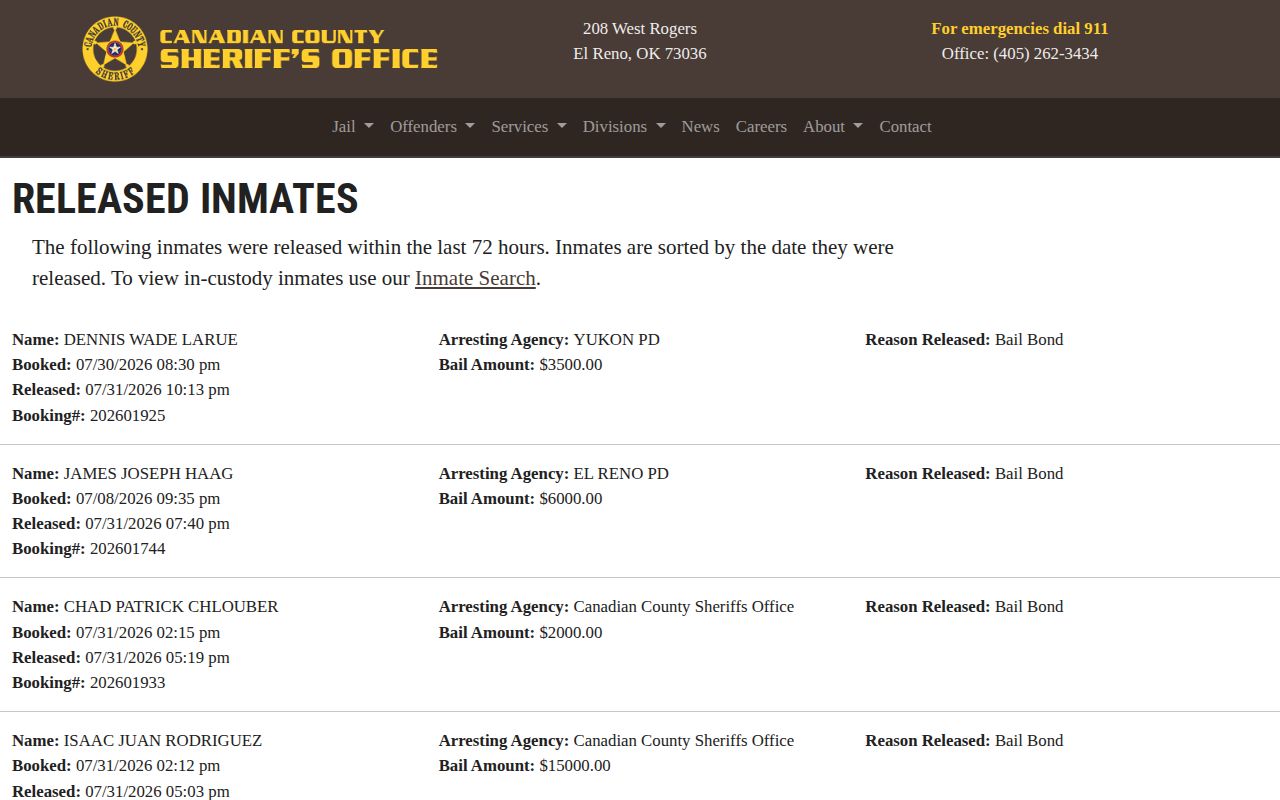
Its displayed dates allow a precise 24-hour slice, but the page gives no update interval and should not be described as real time.
Check Canadian County 24-Hour Releases
A careful check begins with the official release list, not the current inmate roster. The release list records people who left CCSO custody. The roster is expressly limited to people still held by the Canadian County Jail. Keep the two browser pages separate so a current-custody card is not mistaken for a prior release entry.
- Open the official CCSO released-inmates list and note the exact date and local time of access.
- Subtract 24 hours from that point. Compare each displayed Released timestamp with the resulting start and end times.
- Match the full name and booking number when possible. Also compare the booked time and arresting agency.
- Read the Reason Released field exactly as displayed. Do not treat a transfer label as a community release.
- Check the court docket, VINE, ODOC, or the receiving agency when the release reason or later status needs context.
This process answers a feed question: who appears within a one-day interval. It is not a complete search for one named person. For a release outside the rolling period, the Canadian County released-inmate search path combines court, agency, and records-request sources.
Names alone can mislead. Suffixes, alternate spellings, and data entry differences may create false matches. The booking number is the best county identifier when it is available. A no-match should be stated narrowly as no matching public entry found with the inputs and access time used.
Canadian County 24-Hour Release Fields
The official list supplies enough fields to identify a booking and understand the immediate custody event. It does not show charges, a booking photograph, or a clickable profile. Court facts and later custody must be checked in their own systems.
| Field | What it shows |
|---|---|
| Name | The name attached to the Canadian County booking record. |
| Booked | The date and time the recorded jail booking began. |
| Released | The timestamp used to decide whether the entry falls within the last 24 hours. |
| Booking number | The key identifier for matching the entry and requesting the underlying record. |
| Arresting agency | The agency that made or delivered the arrest, not always the agency holding the person next. |
| Total bail | The bail amount displayed with the booking; it does not prove how the criminal case ended. |
| Reason released | The sheriff's recorded route out of CCSO custody, including a bond, plea, dropped hold, or transfer. |
A zero bail figure does not establish dismissal, acquittal, time served, or freedom in the community. Likewise, an arresting-agency label such as Yukon Police identifies the arrest source. It does not turn the CCSO line into a Yukon City Jail release record.
Note: The 72-hour web window is not the sheriff's full retention schedule, which was not published in the researched material.
Read Canadian County Release Reasons
The reason field is the central safeguard against a false conclusion. `Bail Bond`, `Cash Bond`, and `Own Recognizance` describe routes out of county jail while the case may continue. `ENTERED PLEA` points to a court event, but only the docket and judgment can explain the sentence. `HOLD DROPPED` concerns one hold and does not resolve every possible case or warrant.
- Bail or cash bond
- A financial release route recorded by the jail. The criminal case may remain open.
- Own recognizance
- A release without a cash bond based on a legal order and stated conditions.
- Entered plea
- A plea event that needs court records to show the full disposition and sentence.
- TOT OTHER AGENCY
- An explicit handoff to another custodian, not proof that the person entered the community.
Preserve the agency's wording when recording a result. If `TOT OTHER AGENCY` appears, identify the receiving system before describing what happened next. ODOC covers state correctional custody. The Bureau of Prisons covers federal custody. ICE uses its own locator, while another county or municipal jail may require a direct inquiry.
Older Canadian County Release Records
A person released more than three days ago will normally fall outside the public feed. Use the CCSO Records Division for an existing booking and release sheet. A narrow request should name the person, give the booking number if known, set a finite date range, and ask for the recorded booking time, release time, arresting agency, and release disposition. The sheriff's form says the office need not create a record that does not exist.
Records requests go to the Canadian County Sheriff's Office Records Division at 208 W. Rogers in El Reno. The published contact is 405-422-3187 and orrc@ccsheriff.net. The form can be sent by email, but produced records are available for in-person pickup only. Posted charges include $0.25 per copy page and $20 per research hour. Staff presents an applicable search fee for approval before searching, so money should not be sent in advance.
VINE can help with a current event or alert for a known person, but it is not an archive. OSCN supplies court authority and disposition, not the moment jail staff completed a release. ODOC is the correct source when a county detainee moved into state custody. A certified or disputed county release should rest on the CCSO record rather than a transient screen.
Before filing a request, review the wider Canadian County 72-hour release list. An entry that falls outside a one-day filter may still remain in the official window and provide the booking number needed by Records. If the person was booked at Yukon City Jail rather than the county facility, contact Yukon first because no municipal release archive was located. If a federal sentence or FCI El Reno is involved, use the Bureau of Prisons locator instead. These routes prevent a county records request from being sent to an office that never held the relevant release record.
Note: Produced CCSO records not picked up within 90 days may be destroyed, which differs from the agency's underlying record-retention duty.
Canadian County Release or Custody
The current CCSO roster supports only present custody at the time viewed. A matching card means the person is displayed as held. A missing card cannot tell whether there was a release, transfer, spelling mismatch, update delay, sealed material, or custody under another authority.
| What appears | Safe conclusion | Next check |
|---|---|---|
| Current roster card | Displayed in CCSO custody at that moment. | Use jail contact or VINE for a time-sensitive update. |
| Release entry with bond reason | Left CCSO custody by the stated bond route. | Use OSCN for the continuing case. |
| `TOT OTHER AGENCY` | CCSO custody ended through a transfer. | Find the receiving custodian. |
| Absent from both pages | No complete conclusion is supported. | Check records, court, VINE, and other systems. |
The sheriff's Civil Division documents ODOC, warrant, court-order, extradition, and juvenile transports. Movement across systems is routine. A roster disappearance is therefore a prompt to trace custody, not a basis to say someone is free.
Canadian County Sheriff App Limits
CCSO links official Android and Apple applications, but its public website does not document that either app displays recent releases or booking photos. The accurate current claim is limited: the app exists. The verified source for Canadian County 24-hour release filtering remains the sheriff's web list.
The official Android listing identifies the Canadian County Sheriff's Office app.
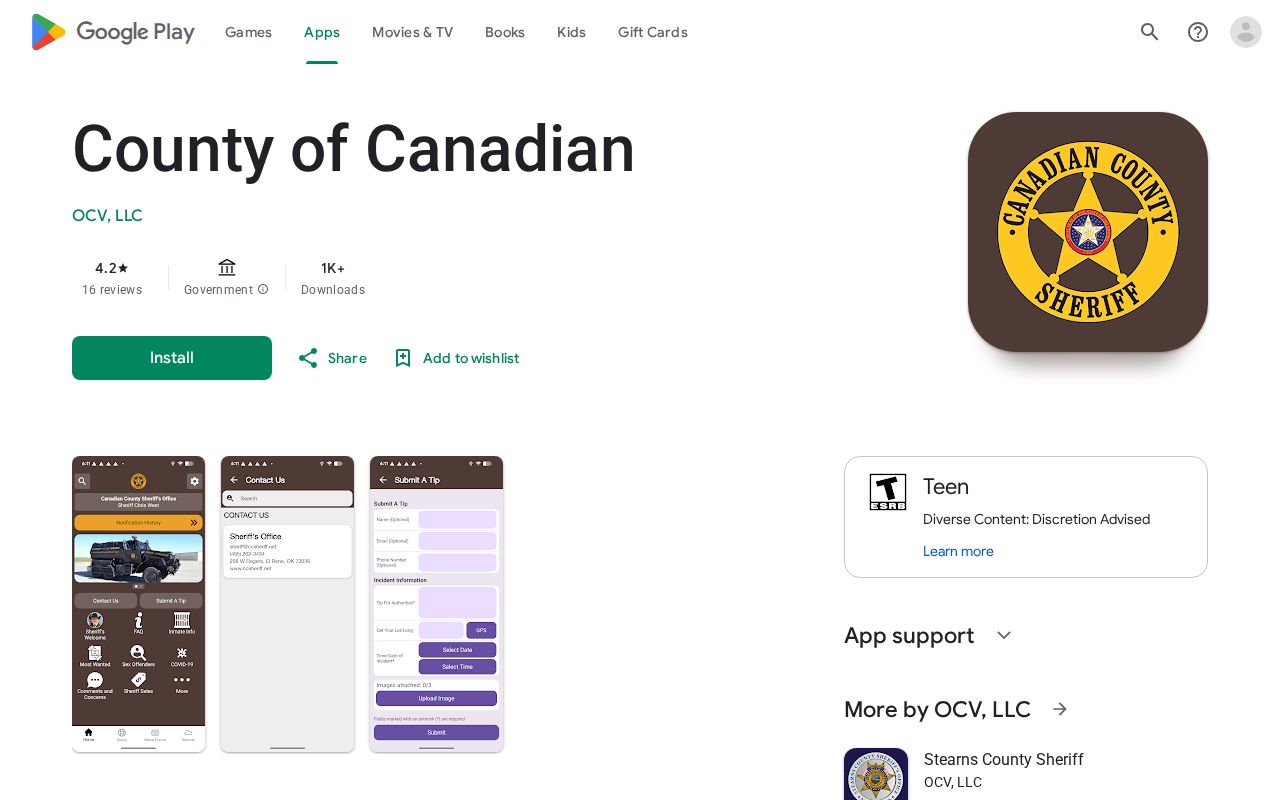
Until a live app screen confirms a specific release feature, do not substitute it for the official web feed or claim that it provides a second recent-release list.
The agency's news and social posts can discuss selected incidents, but they are not a complete release feed. A dated public post may add case context. It should still be reconciled with the booking number, release reason, and official custody source.