
Understanding Canadian County Releases
“Released” describes the end of one custody event, not always the end of all custody. The Canadian County Sheriff's Office records a person's departure from its detention center. A release may mean return to the community, but it may also mean transfer to ODOC, another jail, federal authorities, or ICE. State parole, probation, and community corrections are separate statuses. A person can leave a jail cell and remain under government control.
The official current roster is limited to people held by CCSO when the roster is viewed. Once staff process a departure, the person's card normally leaves that list. That is why absence from the roster is not enough. The Canadian County release reason, the receiving agency, and any court or supervision record must be read together. “Discharge” usually means the end of a correctional sentence or supervision term. “Time served” means the court credits custody already completed. Neither term should be guessed from a missing roster entry.
- Release
- The end of a specific custody episode, whether by community return, court order, or transfer.
- Discharge
- The recorded end of a sentence or supervision obligation, which is more final than leaving one facility.
- Parole
- Supervised release from a prison sentence after the required approval and conditions.
- Probation
- Court-ordered supervision in the community, often tied to a suspended or deferred sentence.
- Detainer
- A request or hold from another authority that can change where a person goes after the local release.
Important: A person who leaves one roster may still be held elsewhere. Confirm the release reason before treating the event as a return to the community.
Canadian County Release Routes
The sheriff's rolling release record preserves the agency's stated reason. Labels observed on the official list include Bail Bond, Cash Bond, Own Recognizance, ENTERED PLEA, HOLD DROPPED, and TOT OTHER AGENCY. Each label answers a narrow question. A bond release can occur while a case continues. A plea needs the judgment and sentence for context. A dropped hold does not prove that every case or detainer ended.
| Release route | What the record supports | Next source |
|---|---|---|
| Bail or own recognizance | The person left CCSO custody under a bond or court release process. | OSCN for the pending case and bond terms |
| Plea or time served | A case event may have supplied authority to release. | Judgment and sentence from the Court Clerk |
| Hold dropped | A stated hold ended, but another matter may remain. | Custodian records and relevant court docket |
TOT OTHER AGENCY | CCSO handed the person to another authority. | ODOC, another jail, BOP, or ICE as applicable |
| Parole or probation | Custody changed to community supervision, not final discharge. | ODOC status and PPB action |
Deaths and transfers can also close a local custody episode without a community release. Use the exact wording in the source. Do not translate a transfer label into “freed,” and do not treat a court order as the exact time a jail door opened.
Canadian County Release Record Fields
The official CCSO released-inmates list is sorted by release date and covers the stated rolling window. Its fields link a departure to the booking that came before it. The page does not display charges, a booking photo, or a profile link. The following inventory reflects the public layout, not an assumed full jail file.
| Field | What it shows |
|---|---|
| Name | The identity displayed for the booking; compare spelling and suffixes carefully. |
| Booked | The date and time the related county booking began. |
| Released | The recorded date and time CCSO ended that custody episode. |
| Booking number | The best local key for a precise records request. |
| Arresting agency | The agency tied to the arrest, not necessarily the next custodian. |
| Total bail | The amount displayed for that release entry; it is not a final court disposition. |
| Reason released | The sheriff's exact release or transfer label. |
The official image below shows the structure of the Canadian County recent-release source. It helps distinguish the release timestamp from the earlier booked time.
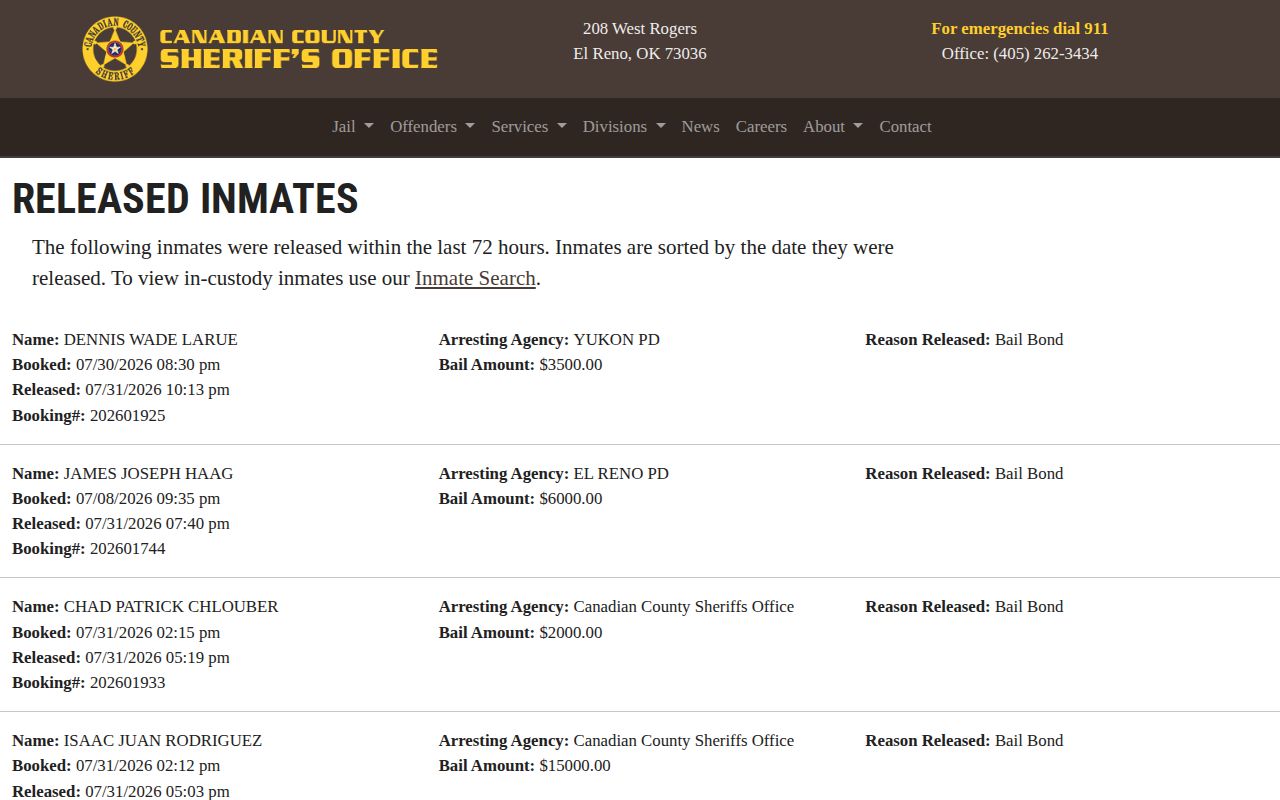
The visible list is a short public window. It is not the sheriff's full retention schedule, so older Canadian County release records require a focused request.
Request Canadian County Release Records
For a release older than the public window, ask the CCSO Records Division for an existing booking and release sheet. A narrow request is easier to locate and less likely to require broad research. Include the full name, a booking number when known, spelling variants that truly matter, and a finite booking or release date range. Ask separately for a booking photograph if it is needed for lawful personal, notification, or court-related use.
- Open the official open-record request form and identify the existing record.
- Request the booking/release sheet, recorded release time, reason, arresting agency, and booking number. Do not ask staff to create an explanation.
- Send the form to
orrc@ccsheriff.net, fax it to 405-422-2430, or deliver it to Records at 208 W. Rogers, El Reno, OK 73036. Questions go to 405-422-3187. - Wait for a fee estimate before sending money. The posted schedule lists $0.25 per copy page, $20 per research hour, and $5 for a USB used for audio or video.
- Pick up produced records in person. The form says records are not mailed, emailed, or faxed and may be destroyed if not collected within 90 days after availability.
The official records page shown here explains the request channels and posted charges.
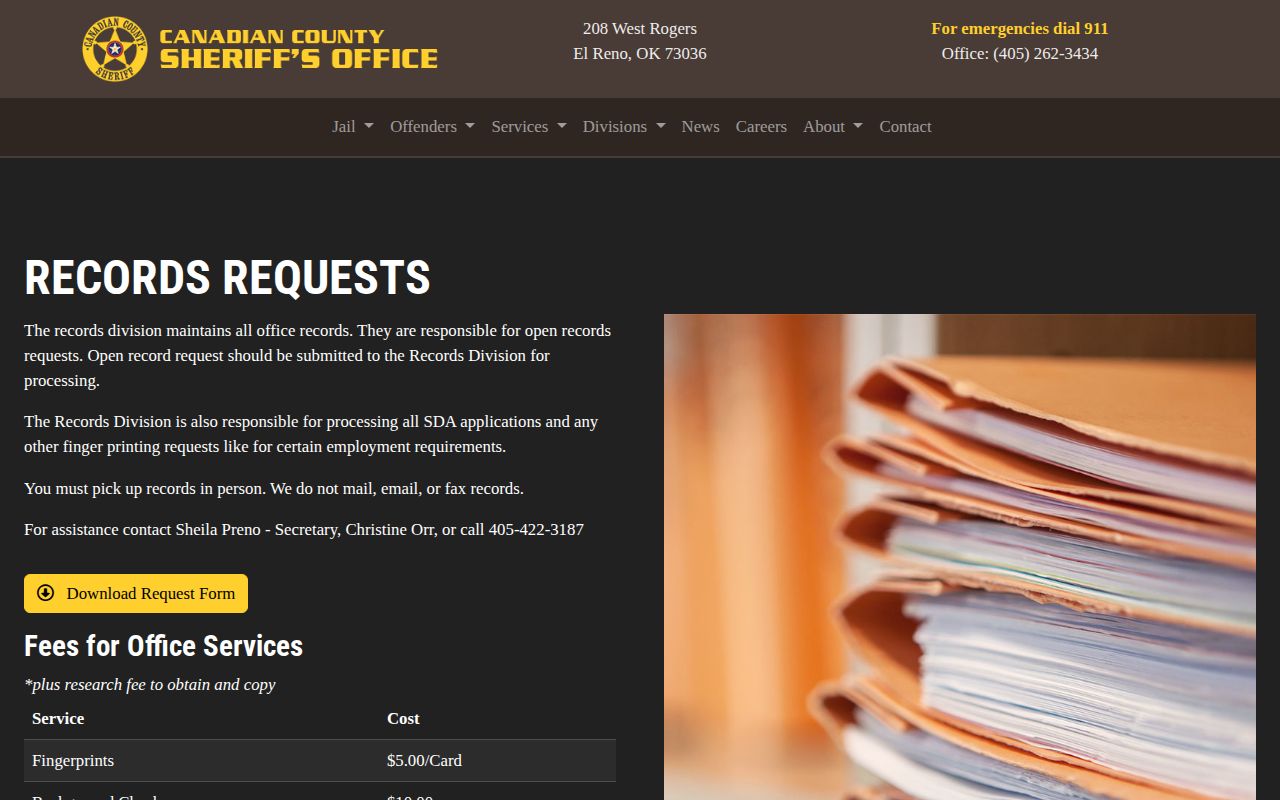
That pickup deadline concerns the prepared response, not the retention period of the underlying jail record. Ask for the agency's current estimate before travel or payment.
Canadian County Record Access Rules
The Oklahoma Open Records Act, 51 O.S. §§24A.1 through 24A.31, governs access to existing public records. Sections 24A.5 and 24A.6 address access and copying, §24A.8 addresses specified law-enforcement records, and §24A.18 says an agency need not create a record it does not possess. The Act does not make every investigative fact, private identifier, juvenile matter, or correctional record public.
Sealing and expungement can also remove a historical public path. Oklahoma's 22 O.S. §18 contains fact-specific eligibility categories, while §19 governs the petition process and notice. An absent search result can reflect a lawful order, an old record not placed online, a spelling issue, or a different custodian. It does not prove that custody never occurred.
Canadian County Court Release Timing
The OSCN docket search supplies the legal story behind many Canadian County jail releases. Select Canadian County, then search by case number when possible. Party name, case type, and date limits help narrow broad results. A docket may show charges, warrants, bond events, a plea, dismissal, judgment, or later order. It normally does not show the exact time detention staff completed a release.
Canadian County's official instruction sheet says most pre-1994 cases are not online and that staff do not conduct record searches by phone. A copy may be needed from the Court Clerk at 301 N. Choctaw, El Reno. The clerk's cash-bond cutoff and direction that a bondsman post at the jail also show why a docket entry and physical exit can occur at different times. Search the court first for legal context, then use the jail release sheet for the recorded handoff time.
Find Canadian County Released Inmates
Begin with the custodian, not a broad name search. Canadian County includes county, municipal, state, federal, immigration, and juvenile systems. A correct name in the wrong system can yield a false conclusion. Use booking, DOC, BOP, A-number, case, and date details only to match the right person. Do not publish protected identifiers merely because they helped with the match.
- For a recent CCSO booking, check the sheriff's 72-hour release list. Compare name, booking number, booked time, arresting agency, release time, and reason.
- If the person remains on the current CCSO roster, there is no displayed county-jail release yet. If absent from both pages, allow for age, lag, spelling, sealing, or another custodian.
- For a state sentence or transfer, search ODOC by DOC number or full name. Read status, location, and sentence panels together.
- Search OSCN for the court disposition. If parole is involved, match the DOC number in PPB dockets and board actions.
- Use VINE for a known person's current custody event and alerts. Use BOP for federal custody and ICE ODLS for immigration custody.
- When the public window has closed or sources conflict, request the release sheet, state certificate, board action, or court document from the office that owns it.
A two-source check is best for a time-sensitive question. Match the custodian's record with VINE, the court, or the receiving agency. Record when each source was checked. Different times may describe different stages without either record being false.
Search Canadian County Recent Releases
CCSO publishes one official rolling window: the 72-hour released-inmates page. There is no separate official 24-hour feed. To view the preceding 24 hours, compare each displayed release timestamp with the current time and retain only matching entries. That is a reader-applied filter, not a second sheriff product. The page does not state an update cadence, so “instant” and “real-time” would overstate the source.
Read the reason before drawing a conclusion. TOT OTHER AGENCY means a handoff. The arresting-agency field identifies who made or delivered the arrest, not where the person went after release. A current roster card supports CCSO custody at the time viewed, while a missing card cannot distinguish release, transfer, lag, a name mismatch, or another agency. Older events should be checked through Records and OSCN.
ODOC Search for Canadian County Releases
The ODOC Offender Lookup covers people committed to state corrections, not every short county-jail booking. Accept its disclaimer, search by ODOC number when available, and otherwise use the full name. Compare identifiers, status or location, and sentence information. A community correctional center or probation/parole office can mean the person left prison but remains under ODOC. Parole is not discharge.
| Search element | How to use it |
|---|---|
| ODOC number | Preferred key for matching a state record. |
| Full name | Fallback field; verify every same-name result. |
| Status or location | Separates prison, community placement, supervision, and closed records. |
| Sentence panels | Provide abbreviated case context, not a full sentence audit. |
| Certificate/status form | ODOC's stronger record for final release or status change. |
The official ODOC search screen pictured below is the correct state entry point for a released or community-status record.
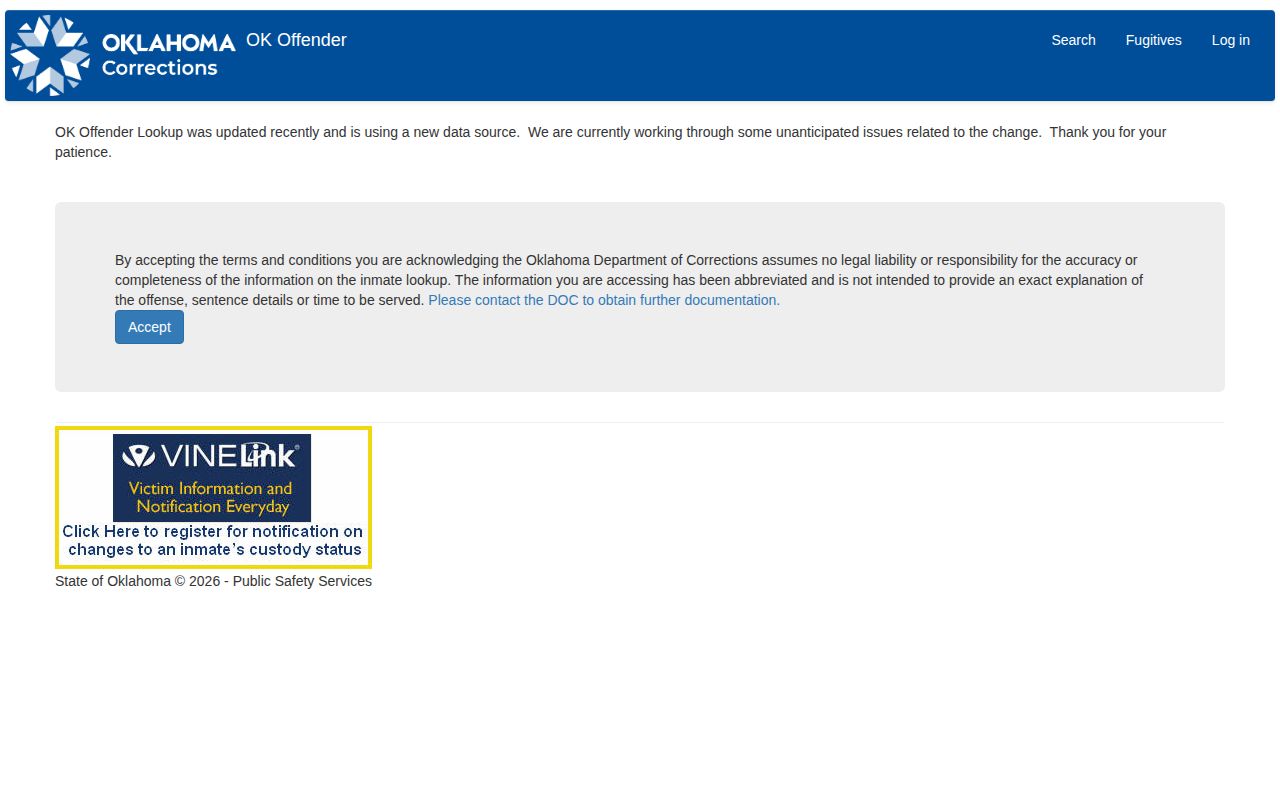
ODOC warns that public data are abbreviated. For a final disposition, request the Certificate of Release or Notice of Inmate Status Change through Offender Records and Registries.
Canadian County Community Custody
Union City Community Corrections Center makes an important distinction local. UCCCC is an ODOC community-security facility with work-release and reentry programming. Authorized work, classes, or other community activity does not by itself end ODOC custody. A resident may spend time outside a secure building yet remain assigned to the state facility.
Parole shifts the person to supervised release. Probation is court-ordered supervision that may follow a suspended or deferred sentence. Full discharge ends the correctional term described by the record. Verify these states in ODOC and, when the exact legal event matters, obtain the Certificate of Release or status-change document. PPB board action may explain a parole decision, but the board record alone does not prove physical departure.
Canadian County ICE Release Handoffs
Canadian County has an official CCSO and ICE 287(g) jail-enforcement memorandum. It documents a supervised process for identifying and processing certain people in sheriff jail facilities. The memorandum alone does not establish that the jail is an ICE contract detention center. Its practical record lesson is narrower: a CCSO departure can lead to immigration processing rather than a return home.
An ICE detainer asks a jail for advance notice and requests custody for up to 48 hours so ICE may assume it. Search the ICE Online Detainee Locator by nine-digit A-number, or by full name, date of birth, and country of birth. ICE says ODLS covers current detainees and some people released from ICE custody within 60 days, excludes minors, and can lag. No result is not definitive.
Canadian County Release Alerts
Oklahoma VINE is a free, confidential way to check a known person and register for custody or supervision notifications. It covers reporting from county jails and ODOC and may carry release, transfer, escape, death, probation, or parole changes. Search by full name or available identifier, verify the reporting agency, and register from the correct record. VINE is an alert system, not a permanent release archive.
Federal custody requires a different tool. The BOP Inmate Locator covers federal inmates from 1982 forward and displays a release date and location. A past date with “Released” or “Not in BOP Custody” establishes departure from BOP, but the person may remain under federal supervision or another authority. FCI El Reno is in Canadian County, yet its releases are federal records rather than CCSO releases.
Canadian County Post-Release Visits
The sheriff's mail and visitation rules attach a local consequence to the recorded release date. A person who was incarcerated in the Canadian County jail may not visit or correspond with a current inmate for six months after the former person's release date. The rule makes an exact release record important for facility access.
This six-month period is not a public-record retention rule. It does not say how long the release entry stays online, and it does not extend the sheriff's stated rolling 72-hour page. For an older date, request the booking/release sheet from CCSO Records. For questions about how the rule applies, call the jail rather than inferring an exception.
Compare Canadian County Custody Records
Each system answers a different custody question. Use the source that owns the event and follow any transfer to its receiving agency.
| Source | Best use | What it cannot prove alone |
|---|---|---|
| CCSO current roster | Current county-jail display | Why an absent person left |
| CCSO 72-hour releases | Recent timestamp and release reason | Older history or another agency's status |
| OSCN | Court order, bond, plea, and disposition | Exact physical exit time |
| ODOC lookup and records | State prison, community custody, supervision, discharge | A short CCSO stay with no state commitment |
| VINE | Status checks and notifications for a known person | A certified historical record |
| BOP or ICE | Federal or immigration custody | County or state custody after a handoff |
Canadian County Release Facilities
Name the custodian before choosing a release tool. The Canadian County Jail / Canadian County Detention Center feeds the sheriff's 72-hour list. The City of Yukon Jail has no researched public release archive, so its jail line and the receiving county or court are the path. Union City Community Corrections Center is an ODOC facility, and FCI El Reno belongs to BOP. The juvenile center is included to prevent an adult-search mistake, but juvenile identities and release details are confidential.
- Canadian County Jail / Canadian County Detention Center: CCSO release record, transfer reason, and Records fallback.
- City of Yukon Jail: municipal inquiry, county handoff check, VINE, and court record.
- Union City Community Corrections Center (UCCCC): ODOC location, parole status, and release certificate.
- Federal Correctional Institution El Reno: BOP locator and federal records.
- Canadian County Juvenile Detention Center: authorized juvenile court or agency process only.
UCCCC's building began as an Avalon high-security juvenile facility in 1999 and was later repurposed for ODOC community inmates. The county jail's dated 2017 account also describes overflow movement to five other counties. Those facts show why geography alone cannot identify the current custodian.